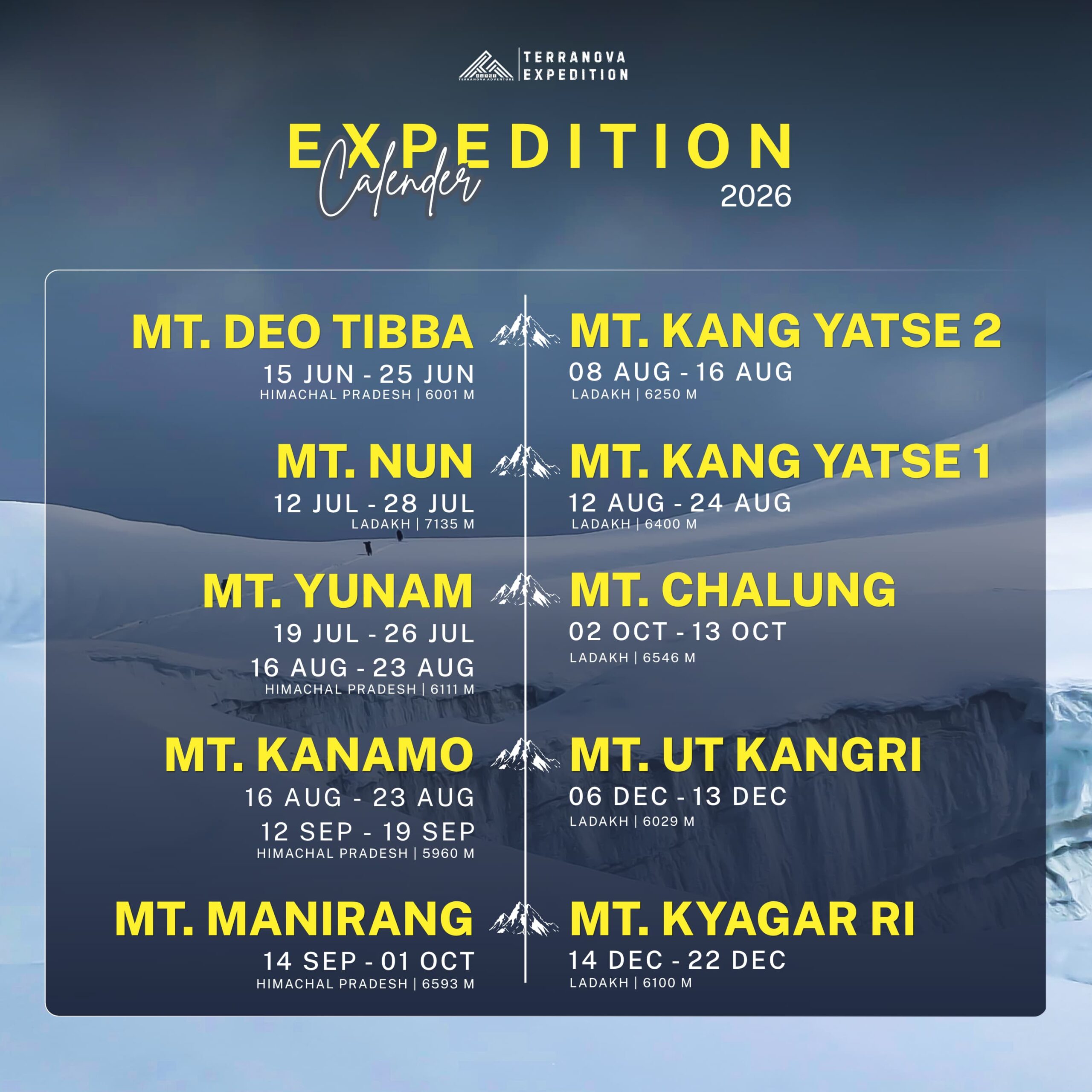
Standing proudly at 6,250 metres (20,505 ft) above sea level, the Kang Yatse II Expedition has become one of India’s most sought-after introductory 6,000-metre mountaineering adventures. Located deep within the breathtaking Markha Valley of Ladakh, this expedition combines the beauty of one of the Himalayas’ finest trekking routes with the excitement of climbing a true Himalayan summit.
Unlike many expedition peaks that require long glacier approaches and extensive technical climbing, Kang Yatse II offers an ideal transition from high-altitude trekking to mountaineering. While the climb still demands excellent fitness, proper acclimatization, and basic snow craft, it is widely regarded as one of the best first 6,000-metre peaks for experienced trekkers looking to expand their mountaineering skills.
The Kang Yatse II Expedition 2026 is expected to attract climbers from across India and overseas due to its stunning landscapes, gradual acclimatization profile, and spectacular summit panorama overlooking the Zanskar and Karakoram ranges.
Whether your goal is to climb your first Himalayan peak above 6,000 metres or prepare for more technical expeditions like Kang Yatse I, Black Peak, or Mt. Kun, Kang Yatse II offers an unforgettable high-altitude experience.
Bookings for Kang Yatse II Expedition 2026 Are Now Open
The Kang Yatse II Expedition 2026 with Terranova Expeditions is now accepting bookings.
Every expedition is professionally managed to maximize climber safety, acclimatization, and summit success.
Our expedition includes:
- Certified expedition leaders
- Experienced mountain guides
- Complete expedition logistics
- Technical climbing equipment support
- High-altitude camping equipment
- Oxygen cylinder and medical backup
- Weather forecasting
- Nutritious expedition meals
- Small expedition teams
- Personalized guidance throughout the climb
Our carefully planned itinerary prioritizes gradual altitude gain, technical preparation, and responsible mountain practices to ensure participants enjoy a safe and rewarding expedition.
Why the Kang Yatse II Expedition 2026 Season Is Special
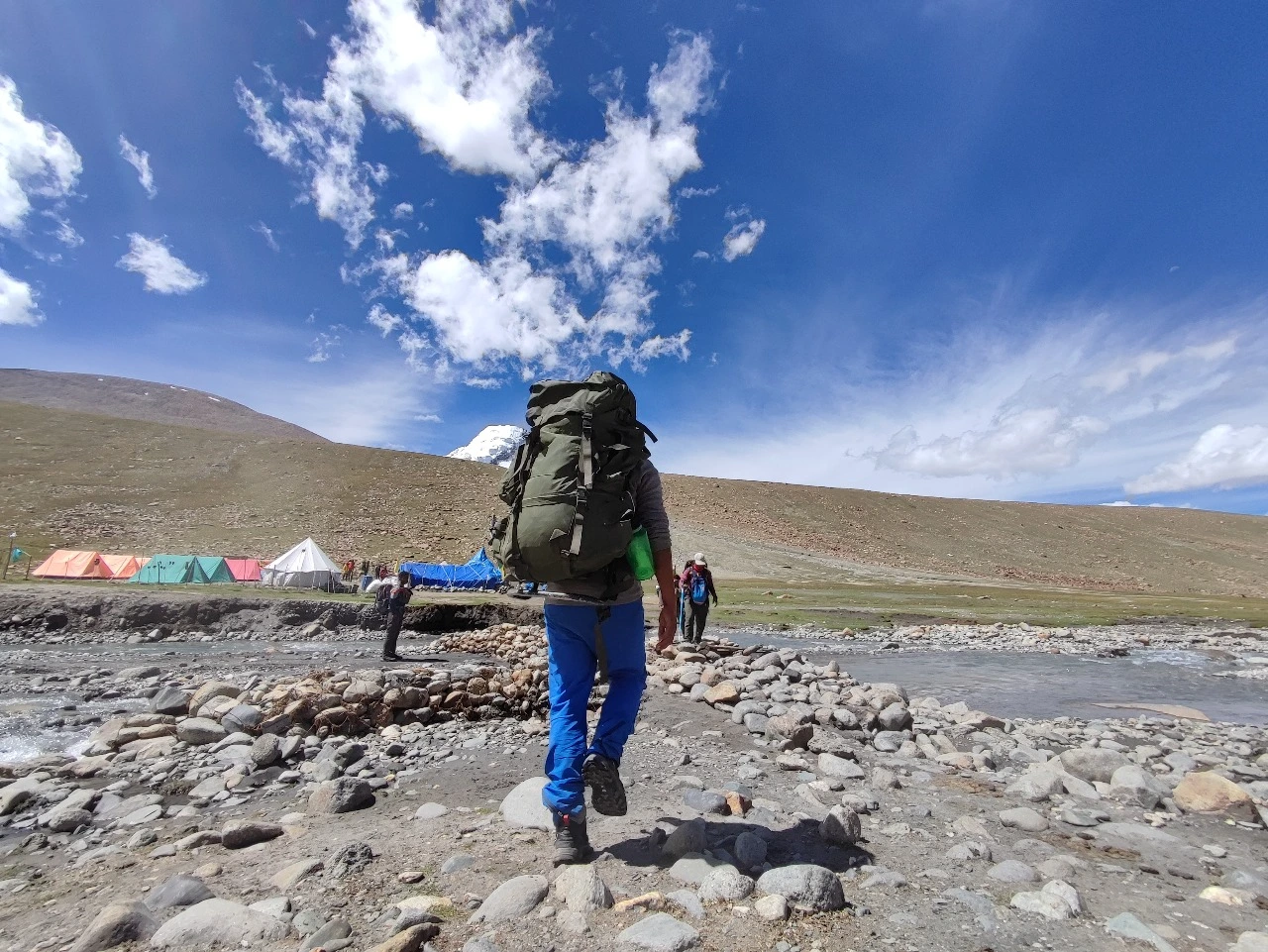
The Kang Yatse II Expedition 2026 season offers several advantages for mountaineers seeking an ideal introduction to Himalayan climbing.
Excellent Climbing Conditions
The expedition operates during the peak Himalayan climbing season between June and September, when Ladakh generally experiences dry weather, stable conditions, and excellent visibility.
These months provide:
- Stable snow conditions
- Clear summit mornings
- Comfortable daytime trekking
- Lower chances of heavy precipitation
- Better summit success opportunities
One of India’s Best Beginner 6000-Metre Expeditions
Among Himalayan expedition peaks, Kang Yatse II occupies a unique position.
It introduces climbers to:
- Snow climbing
- Glacier travel
- High-altitude camping
- Summit strategy
- Expedition life
without the extensive technical demands of more advanced peaks.
For trekkers who have completed routes such as Friendship Peak, Hampta Pass, Buran Ghati, or Kashmir Great Lakes, Kang Yatse II represents an excellent next step.
Trek Through the Legendary Markha Valley
Unlike expeditions that begin directly at Base Camp, the Kang Yatse II Expedition Route follows the spectacular Markha Valley.
This gradual approach provides:
- Better acclimatization
- Beautiful Himalayan scenery
- Authentic Ladakhi villages
- Buddhist monasteries
- River crossings
- High-altitude meadows
- Wildlife sightings
The journey itself becomes as memorable as the summit.
About the Kang Yatse II Expedition
Located inside Hemis National Park, Kang Yatse II rises above the famous Markha Valley and offers one of the finest introductions to Himalayan mountaineering.
Standing at 6,250 metres, it provides the perfect balance between trekking and technical climbing.
Unlike ordinary Himalayan treks, the Kang Yatse II Expedition combines:
- Multi-day approach trekking
- Progressive acclimatization
- Technical training
- Snow climbing
- Glacier movement
- High-altitude camping
- Summit strategy
This combination allows participants to experience every aspect of a professionally managed Himalayan expedition.
Although considered less technical than Kang Yatse I, climbers should not underestimate the challenge.
Altitude alone makes Kang Yatse II a demanding expedition that requires preparation, discipline, and teamwork.
Location of Kang Yatse II
Kang Yatse II is situated within Hemis National Park in the Markha Valley of Ladakh.
The expedition follows one of the most scenic trekking routes in India:
Leh → Skiu → Sara → Markha → Thochungtsey → Kang Yatse II Base Camp → Kang Yatse II Summit → Kongmaru La → Chokdo → Leh
This route gradually transitions from traditional Ladakhi villages to alpine meadows, glacial valleys, and snow-covered mountain terrain before reaching the summit.
Quick Facts About Kang Yatse II Expedition
| Detail | Information |
| Peak Name | Kang Yatse II |
| Elevation | 6,250 m (20,505 ft) |
| Region | Markha Valley, Ladakh |
| National Park | Hemis National Park |
| Base Town | Leh |
| Base Camp | Kang Yatse II Base Camp |
| Expedition Duration | 9 Days |
| Maximum Altitude | 6,250 m |
| Difficulty | Moderate to Difficult |
| Expedition Style | Trekking Peak / Mountaineering Expedition |
| Best Season | June – September |
History of Kang Yatse II
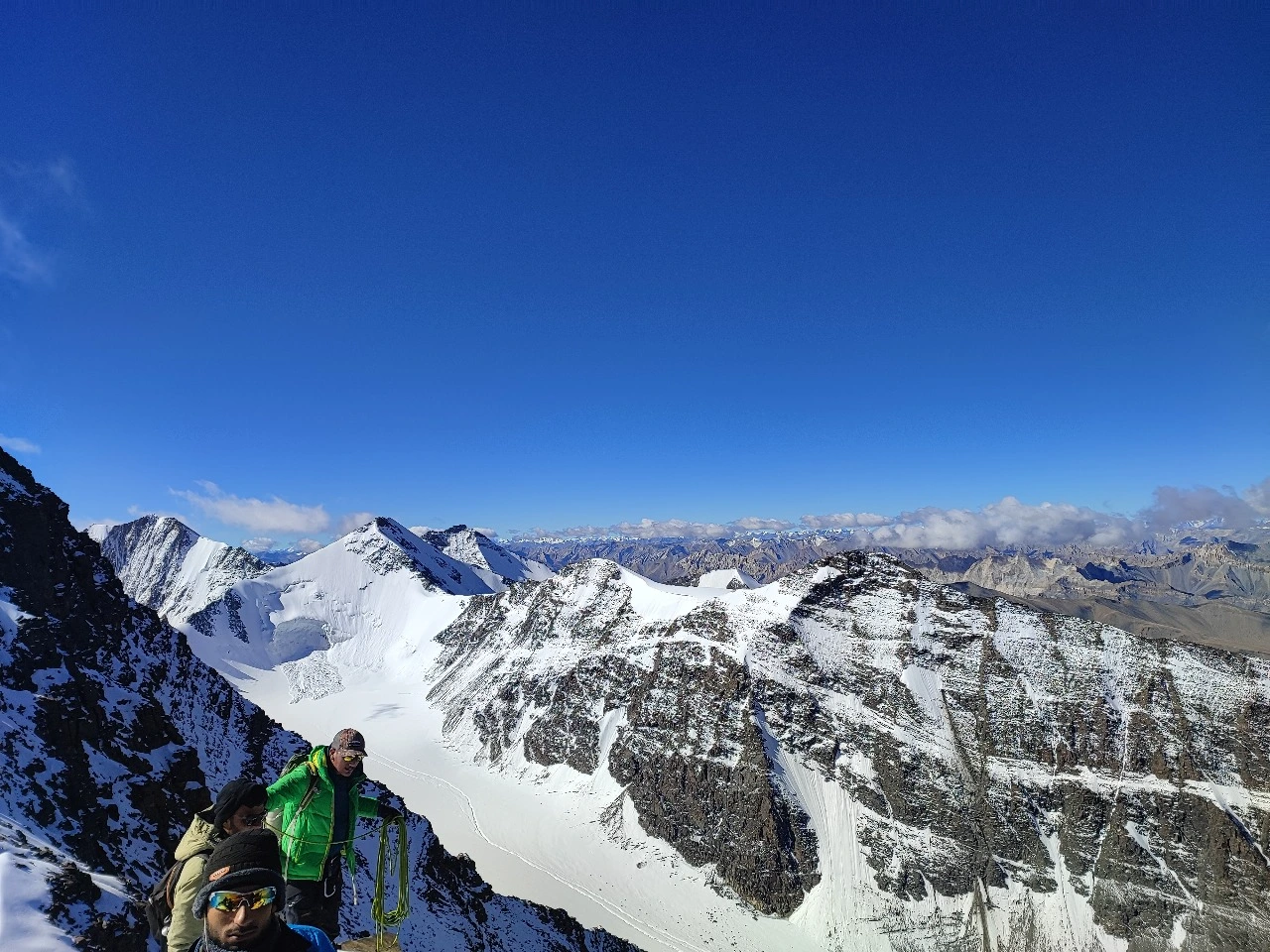
Kang Yatse consists of two distinct summits—Kang Yatse I and Kang Yatse II.
While Kang Yatse I is a more technical alpine climb requiring advanced mountaineering skills, Kang Yatse II has earned a reputation as one of India’s premier introductory expedition peaks.
Over the years, it has become a preferred objective for trekkers transitioning into mountaineering because it provides exposure to high altitude, snow travel, and expedition camping without requiring extensive technical climbing experience.
The peak’s location within Hemis National Park also makes it one of the most culturally rich expeditions in the Indian Himalayas, combining Ladakhi heritage with spectacular alpine scenery.
Why Choose the Kang Yatse II Expedition?
The Kang Yatse II Expedition offers a complete Himalayan experience.
Your First 6000-Metre Peak
For many mountaineers, Kang Yatse II becomes their first successful ascent above 6,000 metres.
It builds confidence while preparing climbers for more technical expeditions in the future.
Incredible Himalayan Landscapes
The expedition traverses:
- Markha Valley
- River crossings
- Alpine grasslands
- High mountain passes
- Glacial terrain
- Snow-covered summit slopes
Every day introduces a new landscape.
Learn Expedition Skills
Participants gain practical experience in:
- Snow climbing
- Crampon walking
- Ice axe use
- High-altitude camping
- Expedition planning
- Summit strategy
- Acclimatization
These skills provide an excellent foundation for more demanding Himalayan expeditions.
Ideal Progression Peak
Many climbers successfully progress from Kang Yatse II to:
- Kang Yatse I
- Black Peak
- Yunam Peak
- Mt. Kun
- Mt. Nun
- Satopanth
making it one of the most valuable stepping stones in Himalayan mountaineering.
Climb with Terranova Expeditions
At Terranova Expeditions, every Kang Yatse II Expedition is conducted with a safety-first philosophy.
Our carefully designed itinerary includes:
- Two acclimatization days
- Professional technical training
- Small expedition groups
- Experienced expedition leaders
- Continuous health monitoring
- Conservative summit strategy
- Premium expedition logistics
This structured approach maximizes learning, safety, and the chances of standing on the summit of one of Ladakh’s most rewarding Himalayan peaks.
Complete Kang Yatse II Expedition Route Explained
From Leh to the Summit of Kang Yatse II
The Kang Yatse II Expedition is much more than a climb to a Himalayan summit—it’s a remarkable journey through the breathtaking landscapes and rich cultural heritage of Ladakh. Unlike many expeditions that transport climbers directly to Base Camp, Kang Yatse II follows the legendary Markha Valley Trek, allowing participants to acclimatize naturally while experiencing one of India’s most scenic high-altitude trails.
The expedition begins in the historic town of Leh, gradually passes through the charming villages of Skiu, Sara, and Markha, before entering the alpine wilderness of Thochungtsey and eventually reaching Kang Yatse II Base Camp. From there, climbers prepare for the ultimate challenge—the ascent of Kang Yatse II (6,250 metres).
This gradual progression is one of the biggest strengths of the Kang Yatse II Expedition 2026. Every campsite has been carefully selected to help climbers adapt safely to altitude while steadily preparing both physically and mentally for summit day.
Unlike rushed itineraries that attempt to gain altitude too quickly, Terranova Expeditions follows a structured expedition plan that prioritizes acclimatization, technical preparation, and safety, significantly increasing the chances of a successful summit.
Kang Yatse II Expedition Route Overview
Leh → Skiu → Sara → Markha → Thochungtsey → Kang Yatse II Base Camp → Kang Yatse II Summit → Kang Yatse II Base Camp → Kongmaru La → Chokdo → Leh
The route combines one of Ladakh’s most beautiful trekking trails with an exciting Himalayan summit climb.
Participants experience:
- Ancient Buddhist villages
- Traditional Ladakhi culture
- High-altitude river valleys
- Alpine meadows
- Glacier-fed streams
- Snow-covered slopes
- Panoramic Himalayan viewpoints
Every day introduces a new landscape while gradually preparing climbers for the ascent of their first 6,000-metre Himalayan peak.
Day 1 – Arrival in Leh (3,500 m)
Your Kang Yatse II Expedition 2026 begins in Leh, the capital of Ladakh and the gateway to some of India’s most spectacular mountaineering expeditions.
Situated at approximately 3,500 metres, Leh itself is already higher than many Himalayan trekking camps. This makes the first day extremely important for acclimatization.
Upon arrival, participants are welcomed by the Terranova Expeditions team before checking into their hotel.
The remainder of the day is intentionally relaxed.
The body immediately begins adjusting to reduced oxygen levels, making rest one of the most important activities of the day.
Participants are encouraged to:
- Drink plenty of water
- Avoid alcohol and smoking
- Eat light, carbohydrate-rich meals
- Take only short walks
- Rest adequately
Expedition Briefing
During the evening, the expedition officially begins with a comprehensive briefing.
Topics covered include:
- Complete expedition itinerary
- Route overview
- Weather conditions
- High-altitude awareness
- Medical protocols
- Team coordination
- Equipment inspection
- Environmental responsibility
Every participant’s personal gear is checked to ensure it is suitable for high-altitude climbing.
Why Leh Is the Perfect Starting Point
Leh offers everything required before entering remote mountain terrain.
It provides:
- Comfortable accommodation
- Reliable medical facilities
- Mountaineering equipment rentals
- Outdoor gear shops
- Banking facilities
- Mobile connectivity
- Last-minute shopping opportunities
Most importantly, spending the first night in Leh allows the body to begin adapting naturally before moving deeper into the mountains.
Day 2 – Acclimatization Day in Leh (3,500 m)
The second day is entirely dedicated to acclimatization.
Many first-time climbers underestimate its importance, but experienced mountaineers know that successful expeditions are often decided before the actual climb begins.
Rather than gaining more altitude immediately, participants allow their bodies to gradually adapt to thinner air.
The day’s objective is simple:
Prepare your body for the higher camps ahead.
Acclimatization Activities
The day usually includes a short acclimatization hike around Leh.
Walking slowly at moderate altitude encourages the body to produce additional red blood cells, improving oxygen transport during the expedition.
Participants also use the day to:
- Organize expedition gear
- Test footwear
- Adjust backpacks
- Finalize clothing
- Hydrate adequately
- Rest before trekking begins
Health Monitoring
Expedition leaders conduct regular health checks, including:
- Oxygen saturation (SpO₂)
- Pulse rate
- Hydration levels
- Sleep quality
- Appetite
- General well-being
Early identification of altitude-related symptoms allows problems to be addressed before entering remote mountain terrain.
Day 3 – Drive from Leh to Skiu & Trek to Sara (3,500 m)
After breakfast, the expedition leaves Leh and drives through the spectacular Indus Valley towards Skiu, the official starting point of the trek.
The drive itself is an unforgettable introduction to Ladakh.
Along the way, participants pass:
- Ancient monasteries
- Colourful prayer flags
- Traditional Ladakhi villages
- The Indus River
- Rugged mountain landscapes
- Dramatic rock formations
Upon reaching Skiu, backpacks are adjusted and the trekking phase officially begins.
Trek to Sara
The trail follows the beautiful Markha River, gradually leading climbers into the famous Markha Valley.
Walking conditions are relatively gentle, allowing everyone to establish a comfortable pace.
The route passes through:
- Wooden bridges
- Willow groves
- Barley fields
- Traditional stone houses
- Prayer wheels
- Ancient Mani walls
Unlike the green forests of Himachal or Uttarakhand, Ladakh offers a dramatic cold-desert landscape where colourful mountains dominate the horizon.
Camp at Sara
Sara is a peaceful campsite situated beside the Markha River.
The open valley provides spectacular evening views while allowing climbers to enjoy their first night under canvas.
As darkness falls, thousands of stars illuminate Ladakh’s incredibly clear night sky, creating one of the expedition’s most memorable experiences.
Day 4 – Trek from Sara to Markha (3,900 m)
Today’s journey introduces participants to the cultural heart of the Markha Valley.
The route gradually gains altitude while following the Markha River through one of Ladakh’s oldest inhabited valleys.
Along the way, trekkers encounter:
- Suspension bridges
- Irrigated farms
- Ancient Buddhist stupas
- Prayer walls
- Traditional mud-brick homes
- Monasteries overlooking the valley
The steady ascent allows the body to continue acclimatizing naturally while enjoying one of the most scenic sections of the expedition.
Markha Village
Markha is the largest settlement in the valley and an important cultural highlight of the expedition.
The village offers a fascinating glimpse into traditional Ladakhi life.
Highlights include:
- Ancient monastery
- Traditional architecture
- Friendly local families
- Agricultural terraces
- Historic trade route heritage
Many climbers spend time exploring the village before returning to camp.
Acclimatization Continues
By now, the expedition has reached nearly 3,900 metres.
Although most participants are adapting well, the expedition leader continues emphasizing:
- Slow walking pace
- Proper hydration
- Nutritious meals
- Adequate rest
Maintaining these habits becomes increasingly important as the expedition climbs higher.
Day 5 – Trek from Markha to Thochungtsey (4,298 m)
Today’s trek marks the transition from inhabited villages into true alpine wilderness.
The landscape changes dramatically.
The fertile valley gradually gives way to expansive grasslands, rocky slopes, and towering snow-covered peaks.
The route follows glacier-fed streams while offering increasingly impressive views of Kang Yatse II, which now dominates the skyline.
For many participants, this is the first time they fully appreciate the scale of the mountain they will soon attempt.
Wildlife Along the Route
The expedition now passes through Hemis National Park, one of India’s richest high-altitude wildlife reserves.
Trekkers may encounter:
- Himalayan Blue Sheep (Bharal)
- Marmots
- Golden Eagles
- Himalayan Griffon Vultures
- Tibetan Snowcock
Although extremely rare, this region is also one of the world’s last strongholds of the elusive Snow Leopard.
Camp at Thochungtsey
Situated in a vast alpine meadow beneath Kang Yatse, Thochungtsey serves as the final trekking camp before reaching Base Camp.
Surrounded by glaciers and rugged mountain ridges, the campsite offers spectacular views throughout the evening.
The atmosphere changes noticeably.
Everyone begins focusing on the technical phase of the expedition that lies ahead.
Day 6 – Trek from Thochungtsey to Kang Yatse II Base Camp (5,100 m)
Today’s climb takes participants into genuine expedition terrain.
The trail gradually leaves the grassy meadows behind before entering rocky moraine, glacial debris, and snow-covered slopes.
Vegetation almost completely disappears.
The surrounding landscape is now dominated by:
- Massive glaciers
- Snowfields
- Ice-covered ridges
- Rocky moraines
- Glacier streams
- Towering mountain faces
The dramatic scenery reminds every climber that they are now operating in one of the harshest yet most beautiful environments on Earth.
Arrival at Kang Yatse II Base Camp
Located at approximately 5,100 metres, Base Camp serves as the operational headquarters for the remainder of the expedition.
Here, climbers prepare for the technical stages leading to the summit.
The afternoon is dedicated to:
- Medical assessment
- Hydration
- Equipment organization
- Weather briefing
- Summit planning
- Rest and recovery
The expedition leader carefully evaluates every participant’s health before approving progression to summit day.
Standing outside the tents, climbers now enjoy uninterrupted views of the imposing summit of Kang Yatse II.
The mountain that once appeared distant across the Markha Valley now rises directly overhead.
Tomorrow begins the final phase of the expedition.
Day 7 – Rest & Technical Training Day at Kang Yatse II Base Camp (5,100 m)
The seventh day of the Kang Yatse II Expedition is one of the most important days of the entire journey. Although there is no significant altitude gain, this day is dedicated to helping every climber adapt to the demanding environment above 5,000 metres while developing the technical skills required for a safe and successful summit attempt.
Unlike regular Himalayan treks, mountaineering expeditions demand much more than physical endurance. Climbers must know how to move efficiently on snow, use technical equipment correctly, and work as part of a coordinated rope team. The Kang Yatse II Expedition 2026 therefore includes a dedicated training day at Base Camp to ensure every participant is fully prepared before attempting the summit.
The objective of the day is simple:
Build confidence, improve acclimatization, and prepare for summit success.
Why a Rest Day Is Essential
Many first-time climbers assume that resting means doing nothing. In reality, acclimatization is an active process.
At 5,100 metres, oxygen availability is significantly lower than at sea level. Moving too quickly to higher camps without allowing the body to adapt greatly increases the risk of Acute Mountain Sickness (AMS) and reduces overall performance.
A scheduled acclimatization day provides several important benefits:
- Better adaptation to high altitude
- Reduced risk of altitude illness
- Improved sleep quality
- Increased energy levels
- More confidence before summit day
- Higher chances of a successful ascent
This carefully planned approach is one of the reasons why professionally guided expeditions achieve better summit success rates.
Technical Mountaineering Training
The training session takes place on nearby snow slopes under the guidance of experienced mountaineering instructors.
Participants receive practical instruction in the essential skills required during the summit climb.
Crampon Walking
Learning to walk efficiently while wearing crampons is one of the first skills introduced.
Training covers:
- Walking on flat snow
- Ascending gentle slopes
- Descending safely
- Traversing snowfields
- Maintaining balance on uneven terrain
Correct crampon technique conserves energy while improving safety on snow-covered slopes.
Ice Axe Techniques
The ice axe is one of the most important safety tools during the Kang Yatse II Expedition.
Participants practice:
- Proper grip
- Walking with an ice axe
- Using the axe for balance
- Self-belay techniques
- Self-arrest in case of a slip
Learning these techniques builds confidence before the summit attempt.
Rope Team Movement
Although Kang Yatse II is less technical than Kang Yatse I, rope techniques may still be required depending on snow conditions.
Participants learn:
- Rope spacing
- Walking as a team
- Communication signals
- Efficient pacing
- Safe movement on snow
Good rope discipline helps maintain safety throughout the expedition.
Glacier Awareness
The upper mountain contains snowfields and glaciated sections that require careful movement.
Training includes:
- Identifying potential hazards
- Safe route selection
- Snow bridge awareness
- Team movement across glacier terrain
- Emergency response procedures
Even when conditions are straightforward, understanding glacier safety is an important part of mountaineering education.
Health Monitoring at Base Camp
Throughout the day, expedition leaders continue monitoring every participant.
Regular checks include:
- Oxygen saturation (SpO₂)
- Pulse rate
- Hydration
- Appetite
- Energy levels
- General well-being
Any signs of poor acclimatization are addressed before summit day.
Life at Kang Yatse II Base Camp
Camping at 5,100 metres offers a completely different experience from lower camps.
Simple daily activities require greater effort due to the reduced oxygen.
Despite the challenging environment, Base Camp is one of the most beautiful locations of the expedition.
The campsite is surrounded by:
- Snow-covered ridges
- Glacial valleys
- Alpine streams
- Endless mountain views
As evening approaches, the summit of Kang Yatse II glows in shades of gold before darkness reveals one of the clearest night skies in the Himalayas.
Final Summit Preparation
During the afternoon, climbers carefully prepare for summit day.
Every participant organizes:
- Summit clothing
- Mountaineering boots
- Crampons
- Ice axe
- Helmet
- Headlamp
- Spare batteries
- Gloves
- Down jacket
- Water bottles
- High-energy snacks
The expedition leader conducts the final equipment inspection to ensure everything is ready.
Summit Briefing
Before dinner, the entire team gathers for the final expedition briefing.
Important topics include:
- Weather forecast
- Planned departure time
- Route conditions
- Rope team assignments
- Emergency procedures
- Turnaround timings
- Communication protocols
Every climber clearly understands the summit strategy before heading to sleep.
An early dinner is followed by several hours of rest before the midnight wake-up call.
Day 8 – Summit Attempt: Kang Yatse II (6,250 m) & Return to Base Camp
The most anticipated day of the Kang Yatse II Expedition has finally arrived.
The summit push usually begins between 12:00 AM and 2:00 AM, when snow conditions are firm and winds are generally calmer.
Outside the tents, temperatures often fall well below freezing.
Headlamps illuminate the darkness as climbers quietly prepare for one of the most rewarding days of their lives.
Leaving Base Camp
Unlike trekking, mountaineering begins long before sunrise.
The team departs in complete darkness, moving slowly across snow-covered terrain.
The only sounds breaking the silence are:
- Boots crunching on frozen snow
- Trekking poles touching the ground
- Gentle instructions from expedition guides
- The wind moving across the mountain
Every climber settles into a steady rhythm.
At high altitude, conserving energy is far more important than moving quickly.
Climbing Towards the Summit
As altitude increases, breathing becomes noticeably slower.
Above 5,800 metres, even small movements require significantly greater effort.
Climbers focus on:
- Controlled breathing
- Short, steady steps
- Efficient pacing
- Staying hydrated
- Maintaining concentration
The gradual ascent allows the body to adapt while reducing fatigue.
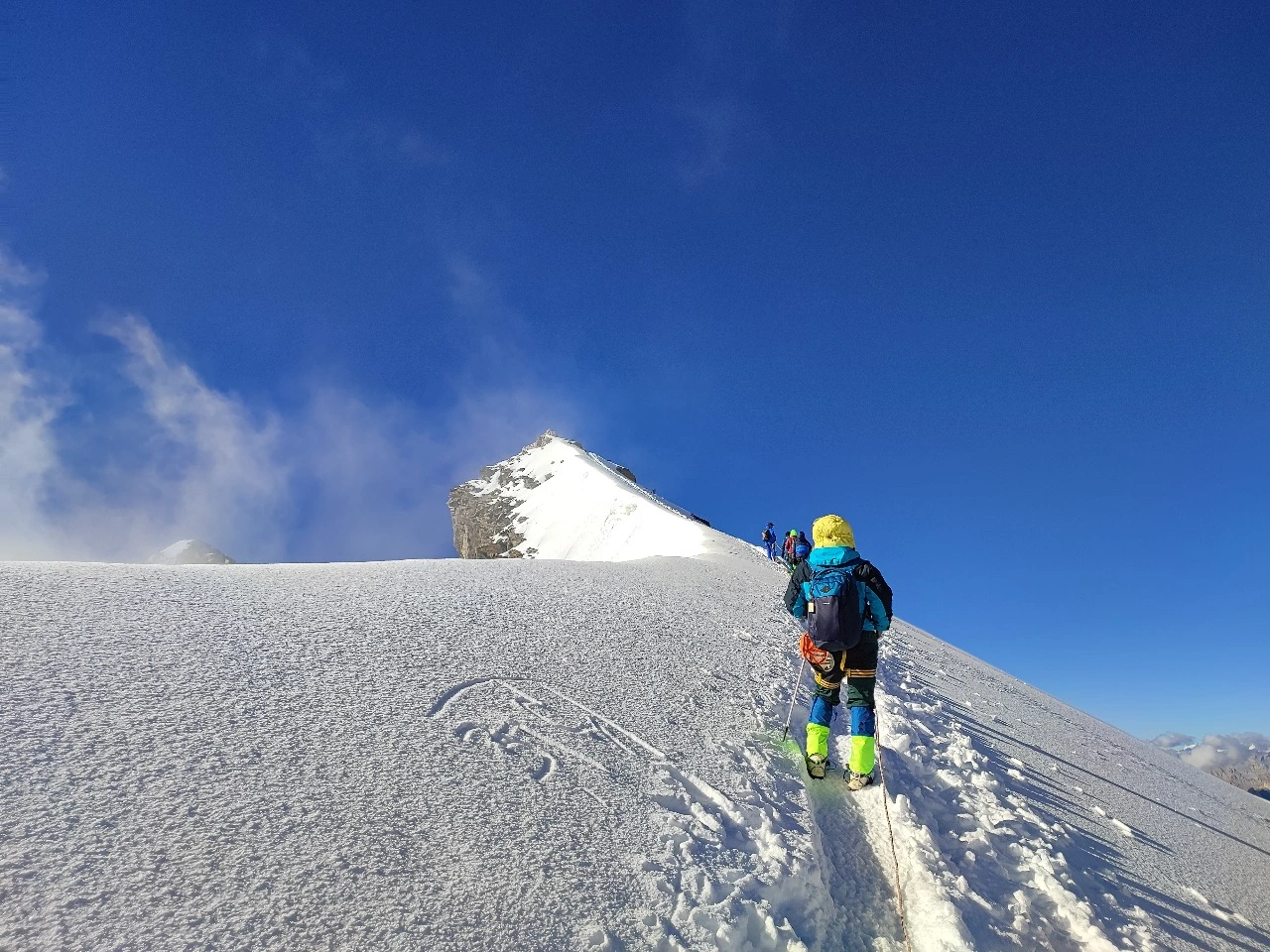
Snow Climbing
The upper slopes consist primarily of snow-covered terrain.
Participants apply the skills learned during the previous day’s training.
These include:
Crampon Technique
Maintaining secure footing while climbing.
Ice Axe Support
Using the ice axe for balance and stability.
Rope Discipline
Following the guide while maintaining safe spacing.
Depending on seasonal conditions, some sections may require fixed ropes, which are managed by the expedition leaders.
Sunrise Above the Himalayas
One of the most unforgettable moments of the Kang Yatse II Expedition occurs shortly before sunrise.
As the first rays of sunlight illuminate the surrounding mountains, the landscape transforms dramatically.
Golden light spreads across:
- Kang Yatse I
- Dzo Jongo
- Stok Kangri region
- Zanskar Range
- Karakoram peaks
- Markha Valley far below
For many climbers, witnessing sunrise above 6,000 metres becomes a lifelong memory.
Reaching the Summit of Kang Yatse II
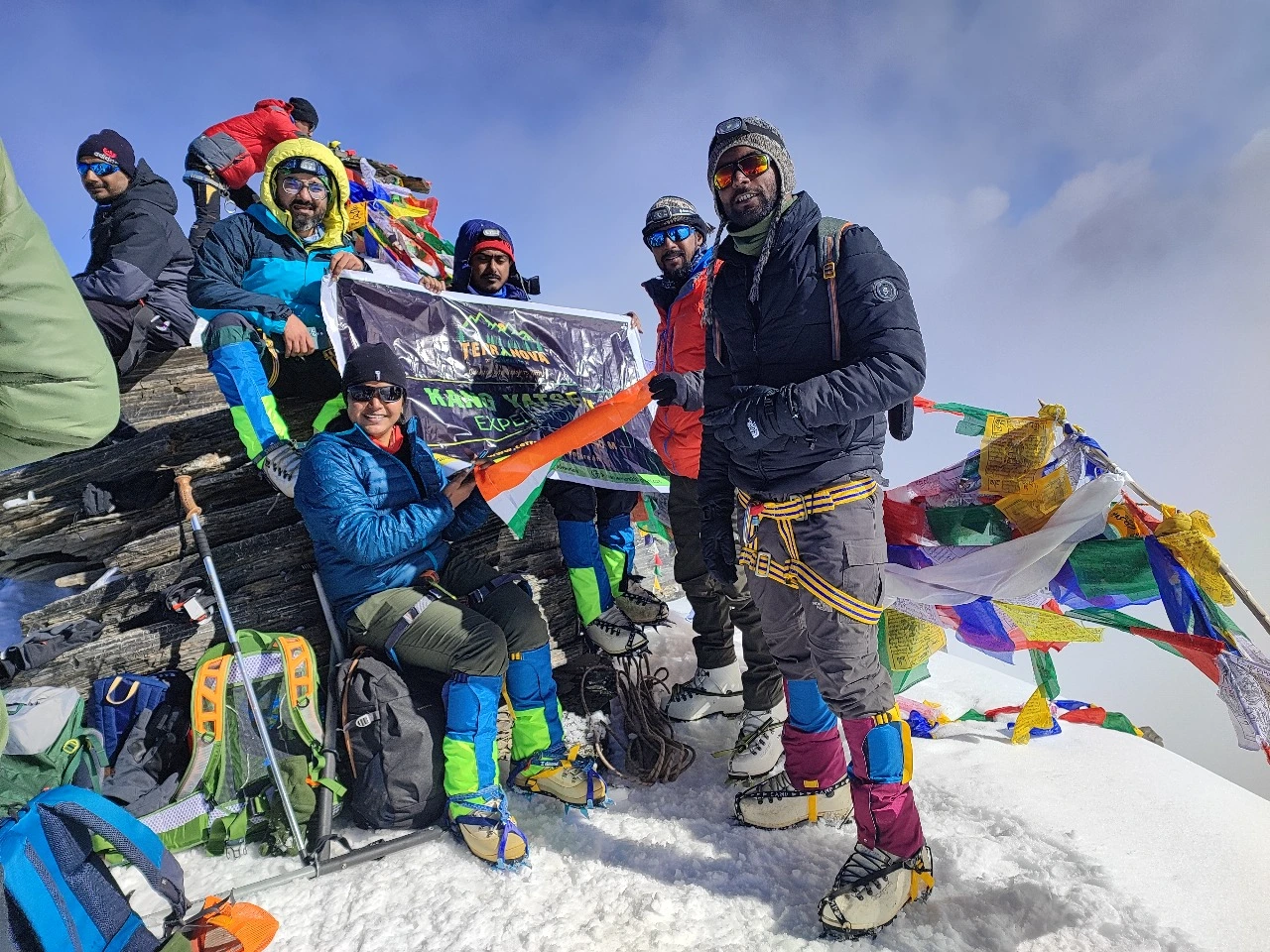
Standing on the summit of Kang Yatse II (6,250 metres) is an extraordinary achievement.
Months of training.
Days of trekking through Markha Valley.
Careful acclimatization.
Technical preparation.
Every step has led to this moment.
The summit offers spectacular 360-degree views across Ladakh’s highest mountain ranges.
On clear days, climbers can admire:
- Kang Yatse I
- Stok Kangri region
- Karakoram Range
- Zanskar Range
- Markha Valley
- Endless snow-covered Himalayan peaks stretching into the distance
For many participants, Kang Yatse II becomes their first successful Himalayan summit above 6,000 metres, opening the door to more advanced mountaineering expeditions.
Summit Celebration
Although reaching the summit is an unforgettable achievement, time spent there remains intentionally brief.
The expedition leader allows sufficient time for:
- Summit photographs
- Team celebration
- Hydration
- Short recovery
Safety always remains the priority.
Soon after, the team begins the descent.
Safe Descent to Base Camp
Experienced mountaineers understand that descending safely is just as important as reaching the summit.
Fatigue, changing snow conditions, and reduced concentration can increase risk during the descent.
The expedition leader carefully manages:
- Team spacing
- Walking pace
- Hydration breaks
- Snow conditions
- Weather monitoring
By afternoon, climbers return safely to Kang Yatse II Base Camp, where a warm meal and well-earned rest await.
The atmosphere at camp is filled with satisfaction, celebration, and stories from one of the most memorable days of the expedition.
Day 9 – Trek to Chokdo via Kongmaru La (5,236 m) & Drive to Leh | Expedition Closure
The final day of the Kang Yatse II Expedition is still packed with spectacular scenery.
After leaving Base Camp, the team climbs towards Kongmaru La (5,236 metres), one of the most scenic mountain passes in Ladakh.
The route offers breathtaking views of:
- Colourful rock formations
- Deep mountain gorges
- Snow-covered peaks
- High-altitude grasslands
- Ancient geological landscapes
Crossing Kongmaru La marks the final major objective before descending to Chokdo.
From Chokdo, vehicles transport the team back to Leh.
Expedition Closure
Back in Leh, the expedition concludes with a closing ceremony celebrating the team’s achievement.
Participants gather to:
- Share memories
- Celebrate the successful summit
- Thank expedition guides and support staff
- Receive expedition certificates
- Capture final group photographs
Although the Kang Yatse II Expedition 2026 officially ends here, for many climbers it marks the beginning of a lifelong passion for Himalayan mountaineering.
Complete Kang Yatse II Expedition Itinerary
| Day | Destination | Activity |
| Day 1 | Leh | Arrival and acclimatization |
| Day 2 | Leh | Acclimatization day |
| Day 3 | Skiu – Sara | Drive and trek |
| Day 4 | Sara – Markha | Trek through Markha Valley |
| Day 5 | Markha – Thochungtsey | Trek and acclimatization |
| Day 6 | Thochungtsey – Kang Yatse II Base Camp | Trek to Base Camp |
| Day 7 | Base Camp | Rest, technical training and summit preparation |
| Day 8 | Kang Yatse II Summit (6,250 m) – Base Camp | Summit attempt and descent |
| Day 9 | Kongmaru La – Chokdo – Leh | Trek, drive and expedition closure |
Lessons Learned from the Kang Yatse II Expedition
Completing the Kang Yatse II Expedition is about much more than reaching a 6,250-metre summit. It is a journey of preparation, patience, resilience, and teamwork.
From the ancient villages of Markha Valley to the snow-covered slopes of Kang Yatse II, every stage teaches valuable lessons in high-altitude mountaineering. Climbers return not only with unforgettable memories but also with greater confidence, stronger technical skills, and a deeper respect for the mountains.
For many adventurers, Kang Yatse II is not the end of the journey—it is the first major step into the world of Himalayan expedition climbing.
If you also wanted to do adventures activities then join us at Terranova Adventure .