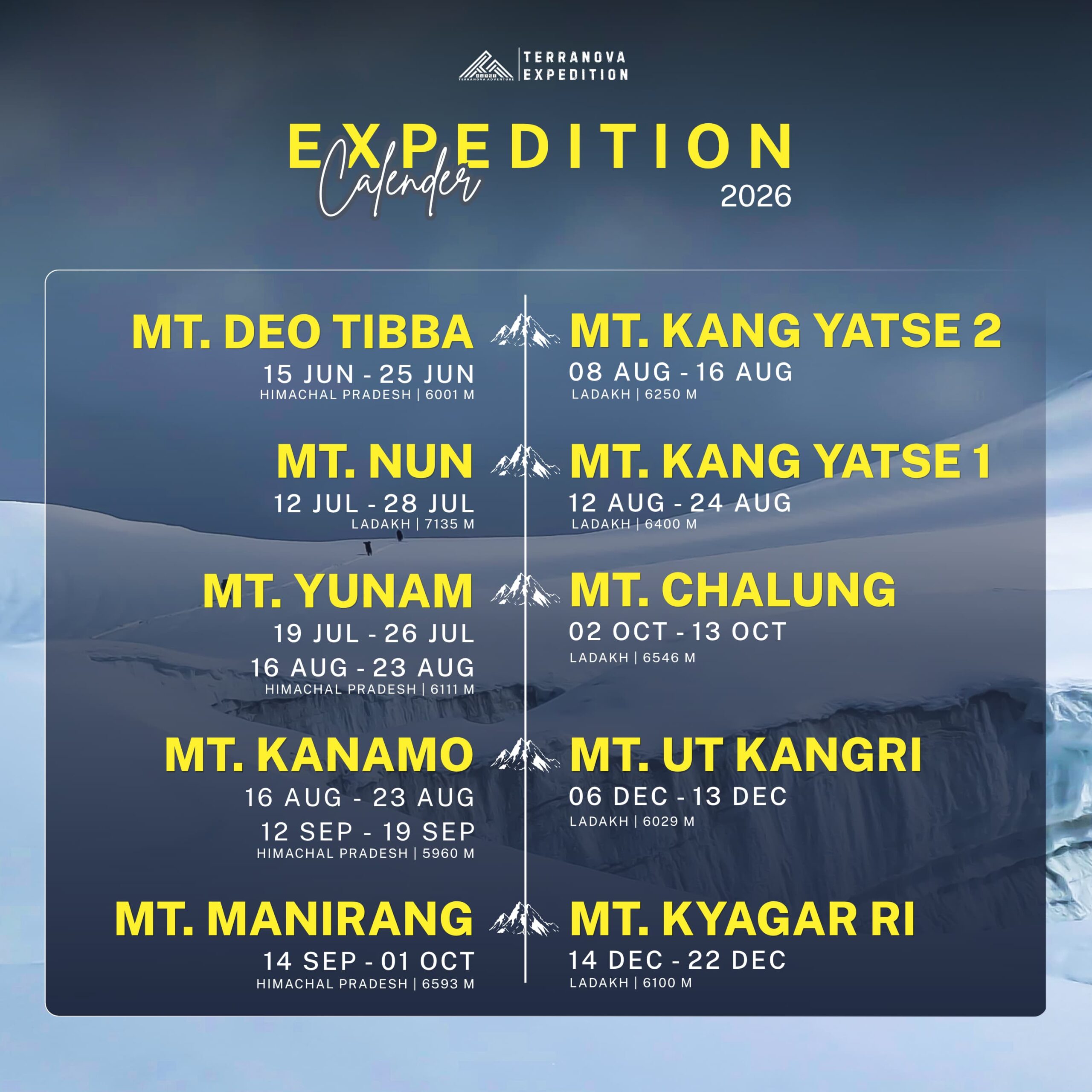
Standing at 6,400 metres (20,997 ft), Kang Yatse I is one of the most challenging and rewarding mountaineering expeditions in the Indian Himalayas. Located in Hemis National Park at the end of the spectacular Markha Valley in Ladakh, this peak is the true summit of the Kang Yatse massif. Unlike its neighbouring Kang Yatse II, Kang Yatse I is a technical alpine climb involving glacier travel, steep snow and ice slopes, fixed rope sections, exposed ridges, and mixed rock terrain. It is designed for experienced climbers looking to step beyond trekking peaks and take on a genuine 6,000-metre Himalayan expedition.
The expedition begins with gradual acclimatization in Leh before entering the breathtaking Markha Valley. The approach passes through traditional Ladakhi villages, high-altitude grazing meadows, and the famous Nimaling campsite, one of the most scenic alpine camps in India. As the journey progresses, climbers establish Base Camp and higher camps while carrying loads, practicing technical climbing skills, and allowing their bodies to adapt to the thin mountain air. This systematic acclimatization plays a crucial role in increasing summit success and reducing the risk of altitude-related illnesses.
Above Base Camp, the character of the mountain changes dramatically. Climbers move across glaciers, negotiate crevasses, ascend steep snow slopes, and climb fixed rope sections using crampons, ice axes, harnesses, ascenders, and other technical mountaineering equipment. Summit day is physically and mentally demanding, often lasting 12–16 hours, with long stretches of technical climbing before reaching the narrow summit ridge overlooking the vast Ladakh and Zanskar ranges.
At Terranova Expedition, the Kang Yatse I Expedition is carefully planned around safety, acclimatization, and technical preparedness rather than speed. Our experienced expedition leaders conduct rope-work practice, equipment familiarization, load-ferry rotations, and continuous weather assessments to maximize safety and summit opportunities. Every decision on the mountain is guided by changing conditions, ensuring that climbers experience a professional, well-managed expedition.
For mountaineers seeking a technically demanding Himalayan climb before progressing to larger international objectives, the Kang Yatse I Expedition offers the perfect combination of alpine climbing, glacier travel, and high-altitude expedition experience in one of the most beautiful mountain landscapes in India.
Kang Yatse I Expedition FAQs
1. Where is Kang Yatse I located?
Kang Yatse I is located in Hemis National Park in the Markha Valley region of Ladakh. The peak belongs to the Zanskar Range and rises above the famous Markha Valley trekking route.
2. What is the height of Kang Yatse I?
Kang Yatse I stands at 6,400 metres (20,997 feet) above sea level, making it one of India’s premier 6,000-metre mountaineering objectives.
3. How difficult is the Kang Yatse I Expedition?
Kang Yatse I is graded Difficult and is a technical alpine expedition. Climbers encounter glaciers, fixed ropes, steep snow slopes, exposed ridges, and mixed rock-and-ice terrain.
4. Is Kang Yatse I suitable for beginners?
No. Kang Yatse I is not recommended for beginners. Climbers should have prior experience on high-altitude expeditions and be comfortable using crampons, ice axe, harness, ascenders, and fixed ropes.
5. What is the difference between Kang Yatse I and Kang Yatse II?
Kang Yatse II is a semi-technical trekking peak suitable for experienced trekkers, whereas Kang Yatse I is the higher and significantly more technical summit, requiring glacier travel and advanced mountaineering skills.
6. What is the best time to climb Kang Yatse I?
The best season is from July to September, when weather conditions are relatively stable and the mountain is most accessible.
7. How many days does the expedition take?
Most Kang Yatse I expeditions last 14–16 days, including acclimatization, technical training, summit preparation, and contingency days.
8. What fitness level is required?
Climbers should be capable of trekking 8–10 hours daily, carrying a loaded backpack, and following a structured fitness program for at least 10–12 weeks before the expedition.
9. Is Kang Yatse I a technical expedition?
Yes. The climb involves:
- Glacier travel
- Fixed rope climbing
- Ice axe techniques
- Crampon climbing
- Snow and mixed terrain
- Rope team movement
10. Is there a risk of altitude sickness?
Yes. Since the expedition reaches 6,400 metres, proper acclimatization, hydration, pacing, and medical monitoring are essential to reduce the risk of Acute Mountain Sickness (AMS).
11. Which permits are required?
The expedition requires Hemis National Park permits, local administrative permissions, and expedition logistics, which are generally arranged by the expedition organizer.
12. What equipment is required?
Essential gear includes:
- Double mountaineering boots
- Crampons
- Ice axe
- Harness
- Helmet
- Ascender and descender
- Down jacket
- Glacier sunglasses
- Headlamp
- Sleeping bag
13. How long is summit day?
Summit day usually begins before midnight and can take 12–16 hours, depending on weather, snow conditions, and the team’s pace.
14. Is prior mountaineering experience mandatory?
Yes. Climbers should have previous experience on 5,500–6,000 metre expeditions or possess equivalent technical mountaineering skills before attempting Kang Yatse I.
15. What accommodation is provided?
Accommodation typically includes:
- Hotels or guesthouses in Leh
- High-altitude expedition tents
- Base Camp and Summit Camp tents during the climb
16. Is mobile network available?
Mobile connectivity is available in Leh but becomes extremely limited or unavailable once the expedition enters the Markha Valley.
17. What are the chances of reaching the summit?
Summit success depends on weather, acclimatization, technical ability, physical fitness, and safe decision-making. No responsible expedition operator guarantees a summit.
18. How cold does it get during the expedition?
Temperatures can fall to -15°C to -25°C at higher camps and during summit night, with significantly colder wind-chill conditions.
19. What is the standard route for Kang Yatse I?
The common route is:
Leh → Markha Valley → Nimaling → Base Camp → Advance Camp → Summit Camp → Kang Yatse I Summit → Return to Leh
20. Why choose Kang Yatse I over other 6,000 m peaks?
Kang Yatse I is ideal for climbers seeking a true technical Himalayan expedition. It combines glacier travel, alpine climbing, spectacular Ladakh landscapes, and advanced mountaineering skills, making it one of the best stepping stones toward larger Himalayan and international alpine objectives.