Himalayan Expeditions from Dehradun are the starting point for some of the most serious and rewarding mountaineering journeys in the Garhwal Himalayas. From Bhagirathi II and Gangotri III to Mt. Shivling, Mt. Thalay Sagar and Mt. Satopanth, Dehradun acts as an important logistical gateway for climbers heading deeper into Uttarakhand’s high mountains.
For many major expeditions in the Garhwal Himalayas, Dehradun serves as an important logistical starting point. From here, roads lead towards Uttarkashi, Gangotri and other mountain regions that provide access to some of India’s most formidable Himalayan peaks.
For climbers joining Terranova Expeditions, this journey can eventually lead towards the Bhagirathi II Expedition, Gangotri III Expedition, Jogin I & Jogin III Expedition, Mt. Shivling Expedition, Mt. Thalay Sagar Expedition or Mt. Satopanth Expedition. Dehradun is also connected with expedition journeys towards other parts of Uttarakhand, including the Mt. Nanda Devi East Expedition, while climbers looking to develop their 6,000-metre experience can explore objectives such as the Black Peak Expedition.
But Dehradun’s importance isn’t about altitude. It is about access, logistics and preparation.
A successful expedition doesn’t begin when a climber puts on crampons at Base Camp. It begins with the decisions made before entering the mountains.
Why Dehradun Is an Important Gateway to the Garhwal Himalayas
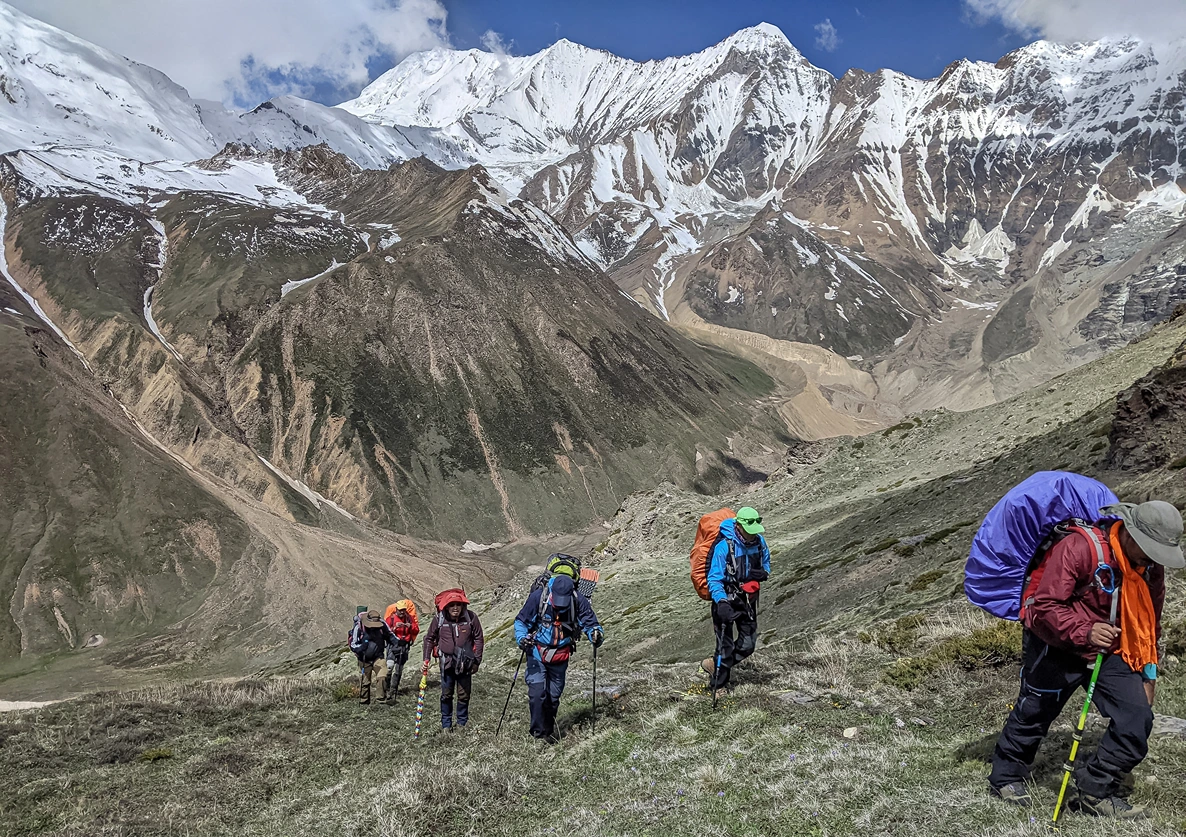
Geography makes Dehradun a natural assembly point for mountaineering expeditions in Uttarakhand.
The city has strong road, rail and air connectivity. Climbers arriving from different parts of India can assemble here before travelling deeper into the mountains, while teams coming from overseas can connect through Delhi and continue towards Dehradun.
More importantly, Dehradun provides road access towards Uttarkashi and Gangotri, one of India’s most important mountaineering regions.
For an expedition team, this accessibility serves a practical purpose.
Before departure, there may be climbing equipment to organise, food and supplies to check, transportation to coordinate, permits and documents to review and last-minute personal gear requirements to resolve.
Once an expedition leaves the city and enters remote Himalayan valleys, solving even a minor equipment problem becomes considerably more difficult.
A missing headlamp battery in Dehradun is an inconvenience.
The same problem at a remote high camp can affect an entire climbing plan.
This is why experienced mountaineers treat expedition preparation with the same seriousness as the summit itself.
Dehradun Is the Starting Point, Not the Acclimatization Point
There is an important distinction every aspiring mountaineer should understand.
Dehradun sits at a relatively low elevation compared with Himalayan Base Camps. Spending two or three days here does not acclimatize a climber for 5,000 or 6,000 metres.
Instead, Dehradun acts as the logistical starting point from which a carefully planned altitude progression begins.
For several Garhwal expeditions, teams travel from Dehradun towards Uttarkashi and Gangotri. Once climbers reach higher elevations, acclimatization becomes a critical part of the expedition.
This gradual transition matters because altitude cannot be defeated by fitness.
A marathon runner can experience Acute Mountain Sickness. So can an experienced trekker. As elevation increases, the body needs sufficient time to adapt to the lower availability of oxygen.
Good expedition itineraries therefore incorporate gradual altitude gain, acclimatization days and, where required, load-ferry or climbing rotations.
On a serious Himalayan expedition, sometimes the most productive day is the day when you climb nowhere.
From Dehradun to Gangotri: Where the Mountains Begin to Take Over
The road journey from Dehradun towards Gangotri is much more than transportation between two points.
As the route climbs through Uttarakhand, city landscapes gradually disappear and the terrain becomes increasingly mountainous. Uttarkashi serves as an important centre along the way before teams continue towards Gangotri.
At approximately 3,400 metres, Gangotri marks a major transition.
For pilgrims, it is one of India’s most sacred Himalayan destinations. For mountaineers, it is also the gateway to an extraordinary concentration of high-altitude climbing objectives.
The surrounding mountains include the Bhagirathi massif, Gangotri group, Shivling and several technically demanding Himalayan peaks.
This is why many expeditions originating operationally from Dehradun eventually converge towards the Gangotri region.
It is also where acclimatization becomes increasingly important. A well-designed expedition may include rest or acclimatization time before moving towards higher camps, allowing climbers to adapt gradually instead of rushing towards Base Camp.
Bhagirathi II Expedition – Entering Serious 6,000-Metre Mountaineering
The Bhagirathi II Expedition takes climbers into one of the most spectacular mountain environments in the Garhwal Himalayas.
Rising to approximately 6,512 metres, Bhagirathi II is part of the impressive Bhagirathi massif above the Gangotri Glacier region.
This is not simply a high-altitude trek with a summit at the end. Climbers must be prepared for expedition-style movement, snow and glacier terrain, changing mountain conditions and long climbing days.
Previous high-altitude experience, strong fitness and familiarity with mountaineering equipment are therefore important.
For climbers developing their Himalayan résumé, Bhagirathi II can provide valuable exposure to serious 6,000-metre mountaineering.
Gangotri III Expedition – A Classic Garhwal Objective
The Gangotri III Expedition, reaching approximately 6,577 metres, takes mountaineers deeper into the dramatic Gangotri mountain landscape.
Its altitude alone makes the expedition demanding, but summit height tells only part of the story.
Snow conditions, route complexity, weather, technical terrain and the cumulative fatigue of living at altitude all influence the difficulty of a Himalayan expedition.
Gangotri III is therefore best suited to climbers who already understand how their bodies perform at altitude and who are comfortable with the fundamentals of mountaineering.
Jogin I & Jogin III Expedition – Building Technical Experience
The Jogin I & Jogin III Expedition provides another important objective within the wider Gangotri region.
These mountains introduce climbers to a serious expedition environment where technical skills, acclimatization and efficient movement become increasingly important.
For mountaineers progressing from introductory peaks towards more demanding 6,000-metre objectives, the Jogin massif can provide valuable experience before attempting some of the region’s more technical mountains.
Mt. Shivling Expedition – One of the Himalayas’ Most Iconic Mountains
Few mountains in the Indian Himalayas are as instantly recognisable as Mt. Shivling.
Rising dramatically above the Gangotri Glacier region, its steep profile has made it one of the most admired mountains in Indian mountaineering.
But visual beauty should never be confused with accessibility.
The Mt. Shivling Expedition is a serious technical mountaineering objective requiring substantial previous experience. Climbers need excellent physical conditioning, technical competence and the ability to operate safely in steep and exposed mountain terrain.
This isn’t a mountain chosen simply because someone has previously reached 6,000 metres.
It is an objective that should be attempted only when a climber’s technical skills and experience genuinely match the demands of the route.
Mt. Thalay Sagar Expedition – Technical Mountaineering at Another Level
If Shivling represents technical Himalayan climbing, Mt. Thalay Sagar pushes that challenge even further.
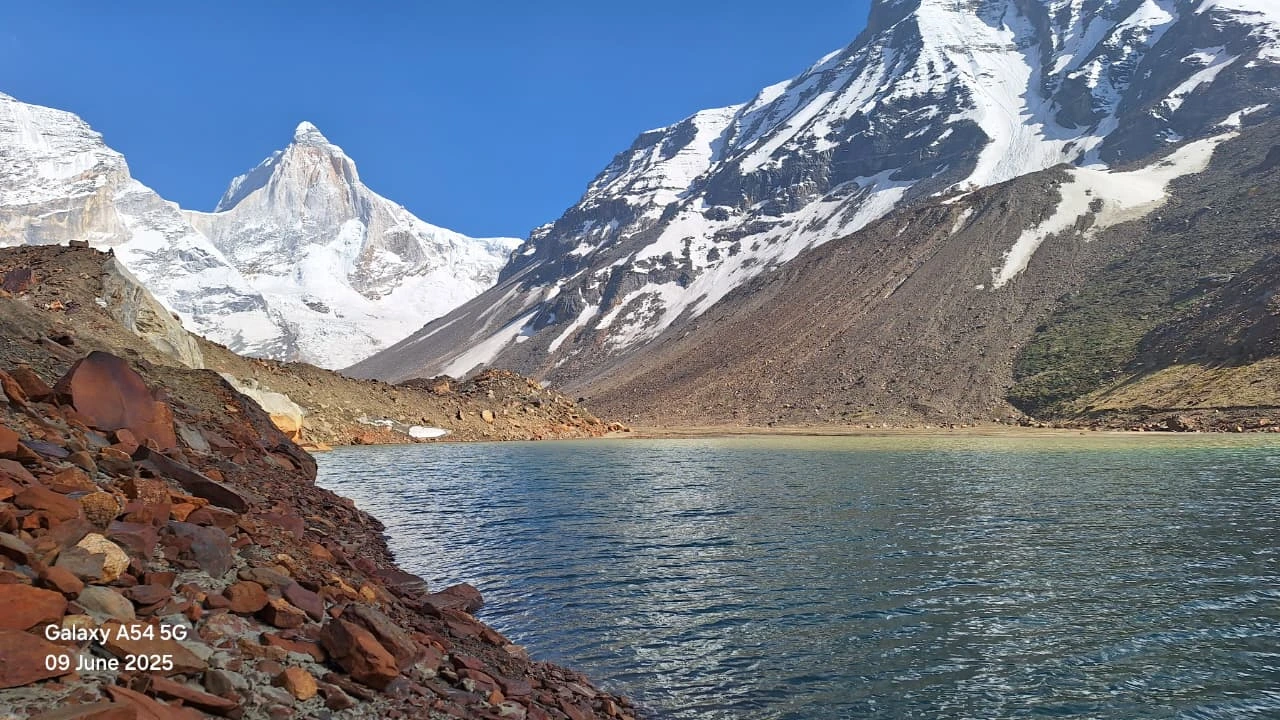
At approximately 6,904 metres, Thalay Sagar rises dramatically above the Kedartal region and is recognised as a highly technical Himalayan objective.
The Mt. Thalay Sagar Expedition demands much more than fitness and altitude tolerance. Climbers must possess significant technical experience and the judgement required for complex alpine terrain.
Terranova’s route progresses from Dehradun towards Gangotri before moving towards the Kedartal side and higher expedition camps.
This illustrates why Dehradun functions as a gateway rather than the mountain destination itself. What begins with an accessible road journey eventually transforms into serious technical climbing in one of Uttarakhand’s most dramatic mountain environments.
Mt. Satopanth Expedition – Stepping Beyond 7,000 Metres
For experienced mountaineers seeking to progress beyond the 6,000-metre threshold, the Mt. Satopanth Expedition represents a major step.
At approximately 7,075 metres, Satopanth demands high levels of physical endurance, technical competence, acclimatization and expedition experience.
The difference between a 6,000-metre and 7,000-metre expedition is not simply another thousand metres.
Recovery becomes slower. Cold becomes more severe. The effects of altitude become increasingly significant. Climbers may spend considerably longer operating in an environment where every movement requires greater effort.
For this reason, Satopanth should be considered part of a mountaineer’s long-term progression rather than simply another summit to add to a list.
Beyond Gangotri: Mt. Nanda Devi East Expedition
Not every expedition connected with Dehradun heads towards Gangotri.
The Mt. Nanda Devi East Expedition belongs to the Kumaon Himalayas and involves a very different approach into one of India’s most extraordinary mountain landscapes.
This distinction is important.
Nanda Devi East should not be grouped geographically with Bhagirathi, Gangotri or Shivling simply for convenient internal linking. It belongs to a separate mountain system and requires its own expedition approach.
For experienced mountaineers, however, it represents another major objective within Terranova’s broader Uttarakhand expedition portfolio.
The mountain demands substantial high-altitude experience, technical competence, endurance and the ability to function effectively during a long Himalayan expedition.
Where Does the Black Peak Expedition Fit?
Another important Uttarakhand objective is Black Peak, also known as Kalanag.
At approximately 6,387 metres, Black Peak is located in the western Garhwal Himalayas and is approached through the Sankri–Ruinsara side rather than the Gangotri climbing corridor.
That geographical difference makes it valuable from an expedition-progression perspective.
The Black Peak Expedition combines altitude, glacier movement, snow terrain and technical mountaineering, making it a serious objective for climbers looking to expand their 6,000-metre experience.
For someone exploring Terranova’s Uttarakhand expeditions, Black Peak provides an alternative to the Gangotri-region peaks while still offering a genuine Himalayan mountaineering challenge.
Choosing the Right Himalayan Expedition
One of the biggest mistakes climbers make is selecting an expedition based almost entirely on summit altitude.
A 6,300-metre mountain is not automatically easier than a 6,500-metre mountain.
Technical grade, route conditions, glacier complexity, objective hazards, summit-day length, weather and previous experience can matter just as much as elevation.
Before choosing an expedition, ask yourself:
- What is the highest altitude I have previously reached?
- Have I already completed a 5,000 or 6,000-metre expedition?
- Can I use crampons confidently?
- Am I comfortable with an ice axe and fixed ropes?
- Have I travelled on glaciers?
- Can I carry a backpack for long mountain days?
- How does my body normally respond to altitude?
- Do my technical skills match the mountain?
There is no shame in choosing a lower or less technical mountain.
In fact, gradual progression is one of the smartest decisions a mountaineer can make.
From 6,000 Metres to Technical and 7,000-Metre Peaks
A sensible mountaineering journey is built step by step.
A climber may begin with demanding high-altitude treks before progressing towards an introductory mountaineering objective. After gaining experience with snow, ropes and altitude, they can move towards serious 6,000-metre expeditions.
With further experience, technical objectives such as Shivling or Thalay Sagar may become realistic.
Eventually, experienced mountaineers may progress towards 7,000-metre mountains such as Satopanth.
The sequence will never be identical for everyone.
The objective is not to climb through a checklist as quickly as possible. It is to ensure that every expedition develops skills that make the next mountain safer.
Preparing Before Leaving Dehradun
The final preparation before entering the mountains deserves attention.
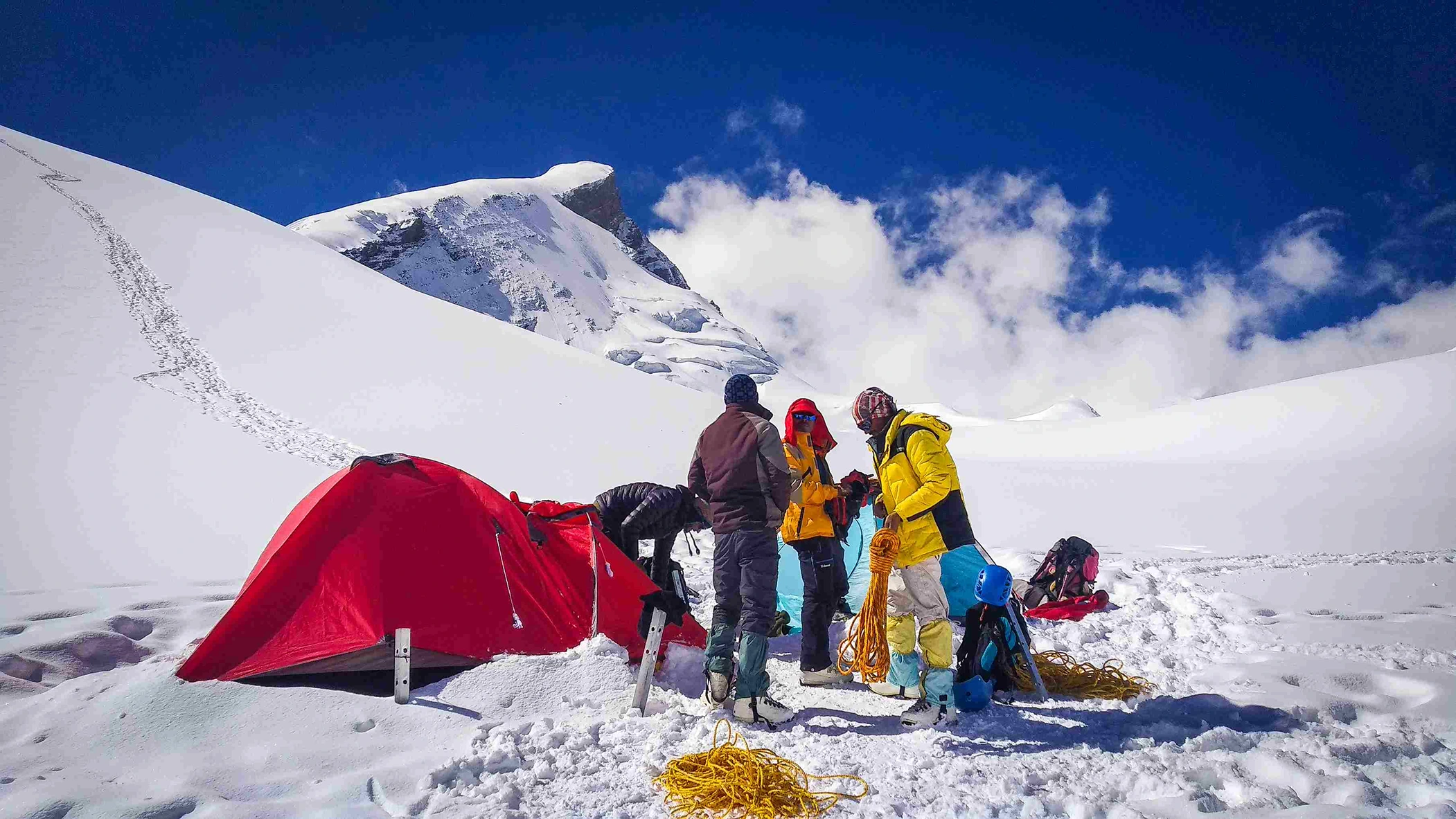
Check your boots carefully. High-altitude mountaineering is not the place to discover that new footwear causes blisters.
Inspect your layering system, gloves, sunglasses, headlamp and spare batteries. Make sure personal medications are packed somewhere accessible rather than buried at the bottom of a duffel bag.
Depending on the expedition, technical equipment may include:
- Mountaineering boots
- Crampons
- Ice axe
- Harness
- Helmet
- Ascender
- Descender
- Carabiners
- Trekking poles
- Glacier sunglasses
- High-altitude down clothing
Physical preparation should already have been completed months before arriving in Dehradun.
Cardiovascular endurance, leg strength, core stability and regular hiking with a loaded backpack should form part of the training programme.
The week before departure is for recovery and preparation—not last-minute fitness.
Acclimatization Can Decide Your Summit Before Summit Day
Experienced mountaineers understand a simple truth:
You cannot negotiate with altitude.
As teams move from Dehradun towards Gangotri and eventually higher camps, oxygen availability decreases progressively.
The body needs time to adapt.
Symptoms such as persistent headache, unusual fatigue, nausea, loss of appetite, dizziness or disturbed sleep should never be ignored.
More serious altitude illnesses, including HAPE (High-Altitude Pulmonary Edema) and HACE (High-Altitude Cerebral Edema), require immediate action.
Good expedition planning therefore includes gradual ascent, hydration, adequate nutrition, health monitoring and acclimatization rotations where appropriate.
Turning around because of altitude illness isn’t expedition failure.
Ignoring serious symptoms can be.
When Is the Best Time for Expeditions from Dehradun?
There is no universal climbing season for every Uttarakhand expedition.
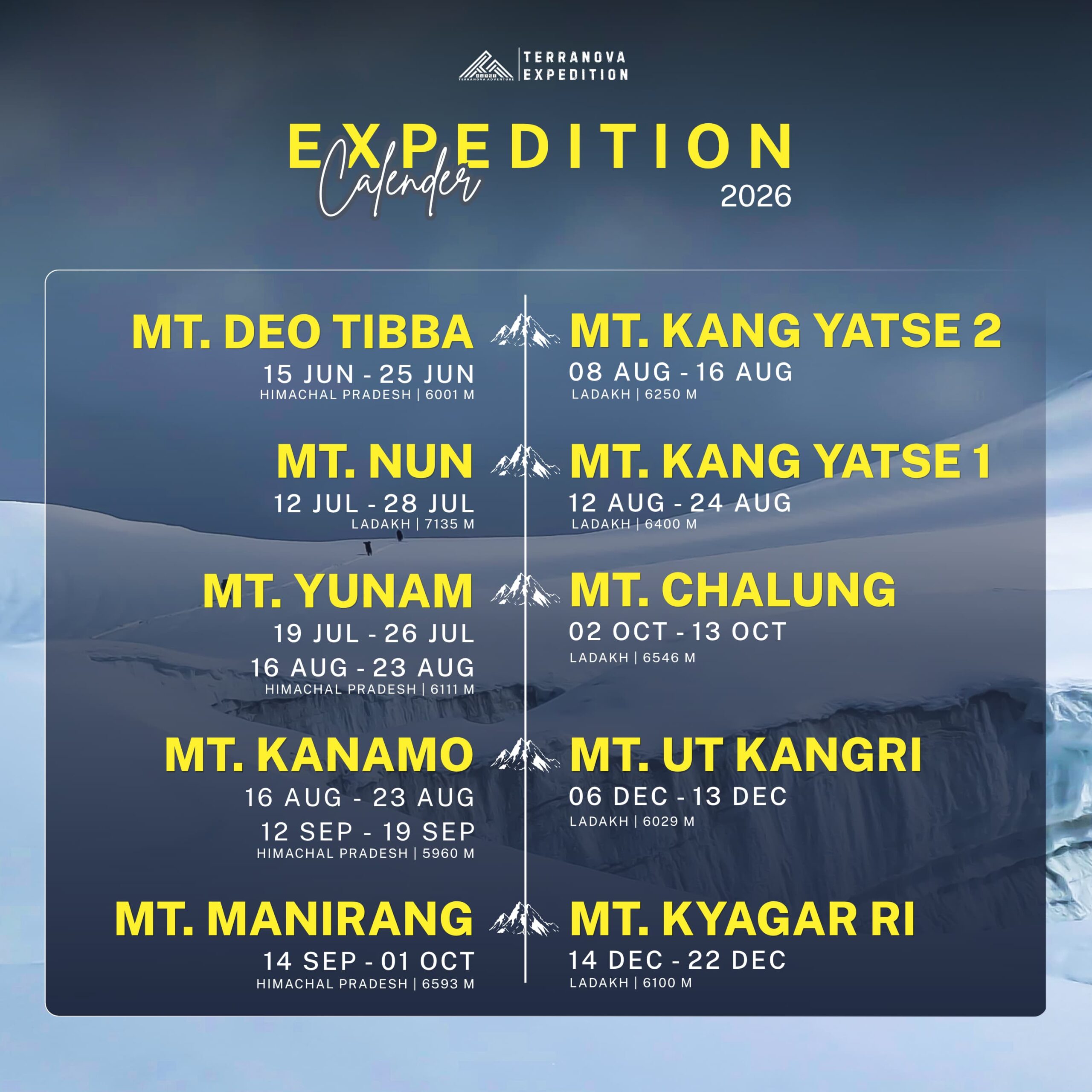
Many Gangotri-region expeditions are attempted during suitable pre-monsoon windows, while certain highly technical objectives may be scheduled during appropriate post-monsoon periods.
Snow conditions, glacier stability, route accessibility, rainfall and temperature all influence the ideal climbing window.
Therefore, don’t choose your mountain simply because you have leave available in a particular month.
Choose the mountain first.
Then choose the season in which that mountain should responsibly be attempted.
Why Choose Terranova Expeditions?
A serious Himalayan expedition involves far more than guiding someone from Base Camp to a summit.
It requires route planning, logistics, equipment management, acclimatization strategy, weather assessment, technical leadership and the ability to make difficult decisions when conditions change.
At Terranova Expeditions, our approach is centred on preparation and progressive mountaineering.
Whether you’re preparing for Bhagirathi II, developing experience on Gangotri III, progressing towards Black Peak, or eventually considering technical objectives such as Shivling, Thalay Sagar or Satopanth, the goal should remain the same: climb within your abilities, learn from every expedition and return safely.
A summit photograph lasts a moment.
The skills and judgement developed on the mountain stay with you for every expedition that follows.
Conclusion
Dehradun may sit hundreds of kilometres from the summit, but for many Uttarakhand expeditions, this is where the journey becomes real.
It is where teams meet, logistics come together and the road towards the Garhwal Himalayas begins.
From Bhagirathi II, Gangotri III and Jogin I & Jogin III to highly technical objectives such as Mt. Shivling and Mt. Thalay Sagar, and eventually a 7,000-metre expedition such as Mt. Satopanth, the mountains beyond Dehradun offer an extraordinary progression for serious climbers.
Other objectives such as Black Peak and Mt. Nanda Devi East reveal just how diverse mountaineering in Uttarakhand can be.
But whichever mountain you choose, remember one principle:
Don’t choose an expedition simply because you want the summit. Choose it because you’re ready for the mountain.
That decision—made long before summit day—is where a successful Himalayan expedition truly begins.
Frequently Asked Questions
1. Why do many Himalayan expeditions in Uttarakhand start from Dehradun?
Dehradun offers excellent air, rail and road connectivity and provides convenient access towards Uttarkashi, Gangotri and other Uttarakhand mountain regions. It therefore works well as an assembly and logistical starting point for expedition teams.
2. Which Terranova expeditions start from Dehradun?
Terranova’s Dehradun-connected expedition portfolio includes objectives such as Bhagirathi II, Gangotri III, Jogin I & Jogin III, Mt. Shivling, Mt. Thalay Sagar, Mt. Satopanth and Mt. Nanda Devi East. Always check the current expedition itinerary because operational arrangements can change.
3. Is Dehradun used for altitude acclimatization?
No. Dehradun is relatively low in elevation and primarily serves as an operational starting point. Acclimatization takes place progressively as teams move towards higher locations such as Gangotri and subsequent expedition camps.
4. How do I reach Dehradun for an expedition?
Dehradun can be reached by air through Jolly Grant Airport, by train through Dehradun Railway Station and by road from Delhi and other major North Indian cities.
5. How early should I reach Dehradun before my expedition?
Follow the reporting date specified in your expedition itinerary. Arriving with sufficient time to rest after travel and resolve any last-minute gear issue is preferable to reaching the assembly point exhausted.
6. How long does it take to travel from Dehradun to Gangotri?
The road journey normally requires a full travel day and can vary substantially with road, weather and traffic conditions. Expedition itineraries may also use Uttarkashi as an intermediate halt depending on the programme.
7. Why is Gangotri important for mountaineering expeditions?
Gangotri provides access towards one of India’s most important high-altitude mountaineering landscapes, including the Gangotri Glacier region and peaks such as Bhagirathi, Gangotri and Shivling.
8. Can I develop altitude sickness after travelling from Dehradun to Gangotri?
Yes. The altitude gain is significant. Anyone can develop Acute Mountain Sickness, irrespective of fitness, which is why gradual acclimatization and monitoring symptoms are important.
9. Is Bhagirathi II suitable for beginners?
Bhagirathi II should not be treated as a beginner trek. It is a serious 6,000-metre mountaineering expedition, and previous high-altitude and relevant climbing experience are recommended.
10. How difficult is the Gangotri III Expedition?
Gangotri III is a demanding high-altitude mountaineering objective. Difficulty depends not only on its approximately 6,577-metre altitude but also on snow, glacier, weather and route conditions.
11. What experience is required for Jogin I & Jogin III?
Climbers should have strong physical conditioning, previous high-altitude exposure and appropriate mountaineering experience. Exact prerequisites should be checked against Terranova’s current expedition requirements.
12. Is Mt. Shivling suitable for first-time mountaineers?
No. Mt. Shivling is a serious technical mountain requiring substantial previous climbing experience and competence in technical alpine terrain.
13. Why is Thalay Sagar considered a highly technical expedition?
Thalay Sagar is known for steep and complex climbing terrain. Its difficulty comes from the combination of technical climbing, exposure, altitude and objective mountain hazards rather than summit elevation alone.
14. Is Mt. Satopanth higher than 7,000 metres?
Yes. Mt. Satopanth rises to approximately 7,075 metres, placing it firmly in the category of major high-altitude Himalayan expeditions.
15. What experience is required for Mt. Satopanth?
Climbers should already possess substantial high-altitude mountaineering experience, strong technical skills and experience operating on previous major Himalayan expeditions.
16. Is Mt. Nanda Devi East approached through Gangotri?
No. Nanda Devi East belongs to the Kumaon Himalayas and follows a different approach. It should not be confused geographically with Gangotri-region expeditions.
17. Does the Black Peak Expedition start through Gangotri?
No. Black Peak (Kalanag) is approached through the western Garhwal side, commonly associated with the Sankri–Ruinsara region. It is a separate Uttarakhand expedition objective.
18. What fitness is required for a 6,000-metre Himalayan expedition?
Climbers need strong cardiovascular endurance, leg and core strength, the ability to hike for several hours with a loaded backpack and previous experience at altitude. Training should begin several weeks or months before departure.
19. Do I need a mountaineering course before these expeditions?
Requirements vary by peak. For highly technical mountains such as Shivling and Thalay Sagar, substantial technical training and previous climbing experience are essential. Less technical objectives may have different prerequisites.
20. How do I choose between Black Peak, Bhagirathi II, Shivling and Satopanth?
Choose according to technical experience, previous maximum altitude, expedition history and long-term climbing goals, not simply summit height. Black Peak and Bhagirathi II can help develop 6,000-metre experience, while Shivling is significantly more technical and Satopanth introduces the additional demands of climbing above 7,000 metres.