Black Peak, also known as Kalanag, is entering another important climbing cycle as mountaineers prepare for the post-monsoon 2026 season and the pre-monsoon 2027 season. Rising to approximately 6,387 metres (20,955 ft) in the Garhwal Himalayas of Uttarakhand, the mountain combines glacier travel, crevasse navigation, steep snow and ice, high-altitude camps, and a demanding summit push.
For anyone planning a Black Peak Expedition, snow conditions matter far more than simply asking whether the mountain has “good weather.” Snow depth, overnight freezing, glacier exposure, crevasse bridges, ice hardness and recent precipitation can all affect the route.
This Black Peak Snow Report 2026–27 brings together the latest available regional weather information, known characteristics of the normal climbing route, recent expedition information and seasonal patterns to provide a practical picture of what climbers may encounter.
Important update — 22 September 2026: There is currently not enough publicly verifiable, expedition-level field reporting from Black Peak’s upper camps to claim exact snow depth at Base Camp, Camp 1, Summit Camp or the summit. Therefore, this report does not present estimated snow depths as measured observations. Conditions above Base Camp should always be verified by the expedition leader and route-opening team on arrival.
Black Peak Snow Report 2026–27: Quick Status
Mountain: Black Peak / Kalanag
Altitude: 6,387 m / approximately 20,955 ft
Region: Garhwal Himalayas, Uttarkashi, Uttarakhand
Primary climbing windows: May–June and September–October
Typical approach: Sankri – Taluka – Seema/Osla region – Ruinsara Tal – Kyarkoti – higher camps
Terrain above Base Camp: Moraine, glacier, snowfields, crevasses, steep snow/ice and exposed upper slopes
As of 22 September 2026, Uttarkashi is still experiencing transitional late-monsoon weather. The India Meteorological Department’s Uttarkashi forecast issued on 21 September indicated partly cloudy conditions with possibilities of rain or thunderstorms during 22–25 September, followed by one or two spells of rain or thundershowers on 26–27 September.
This is relevant to Black Peak because continued precipitation in the district can affect approach trails, river crossings, road access and the snow/rain boundary at higher elevations. It does not, however, provide direct measurements from the Kalanag glacier or summit.
Recent rainfall has already affected parts of Uttarkashi district. In early September, continued rainfall contributed to landslides and unstable slopes, while further road disruptions were reported in the district during mid-September.
For climbers heading toward Black Peak in late September 2026, this means the expedition should be treated as a transition from monsoon conditions toward the generally drier post-monsoon climbing period rather than assuming that stable autumn conditions have already fully established themselves.
Where Is Black Peak?
Black Peak lies in the western Garhwal Himalayas and is closely associated with the Bandarpunch–Swargarohini mountain system. Its distinctive appearance gives rise to the name Kalanag, or “Black Cobra.”
The summit reaches 6,387 metres, and historical climbing accounts describe the normal route as involving glacier travel followed by increasingly steep snow and ice terrain near the upper mountain. A documented ascent published by the American Alpine Club describes climbers reaching a high col around 19,500 ft before negotiating a steep final section approaching the summit cornice.
Modern commercial expedition itineraries generally approach the mountain from Sankri through the Ruinsara Valley before establishing Base Camp around the Kyarkoti area.
Unlike a normal Himalayan trek, the upper section of Black Peak is a genuine mountaineering environment. Climbers must be prepared for:
- Glacier travel
- Crevasse navigation
- Fixed-rope movement
- Crampon use
- Ice-axe techniques
- Jumar ascending
- Rappelling
- High-altitude camping
- Long summit-day exposure
That is why understanding snow and ice conditions is an essential part of planning the Black Peak Expedition.
Current Black Peak Conditions — September 2026
The most important point for September 2026 is that regional monsoon influence has persisted relatively late.
During September, Uttarakhand experienced repeated rainfall and landslide-related disruptions. In Uttarkashi district, rain contributed to slope instability and road closures earlier in the month.
The IMD forecast for Uttarkashi around 22–27 September continued to show chances of rain and thunderstorms rather than a completely dry weather pattern.
For Black Peak teams, these regional conditions have several possible implications.
First, the approach from Sankri toward the higher valley may remain wet in places. Mud, slippery rocks, swollen streams and landslide-affected road sections can sometimes make the approach slower even when conditions higher on the mountain appear suitable.
Second, precipitation falling as rain at lower elevations may fall as snow or mixed precipitation much higher on the mountain.
Third, repeated cloud formation can reduce visibility around glacier terrain.
However, these are operational implications, not confirmation of specific conditions currently existing at Black Peak Summit Camp.
A responsible snow report must make that distinction.
Black Peak Base Camp Snow Conditions
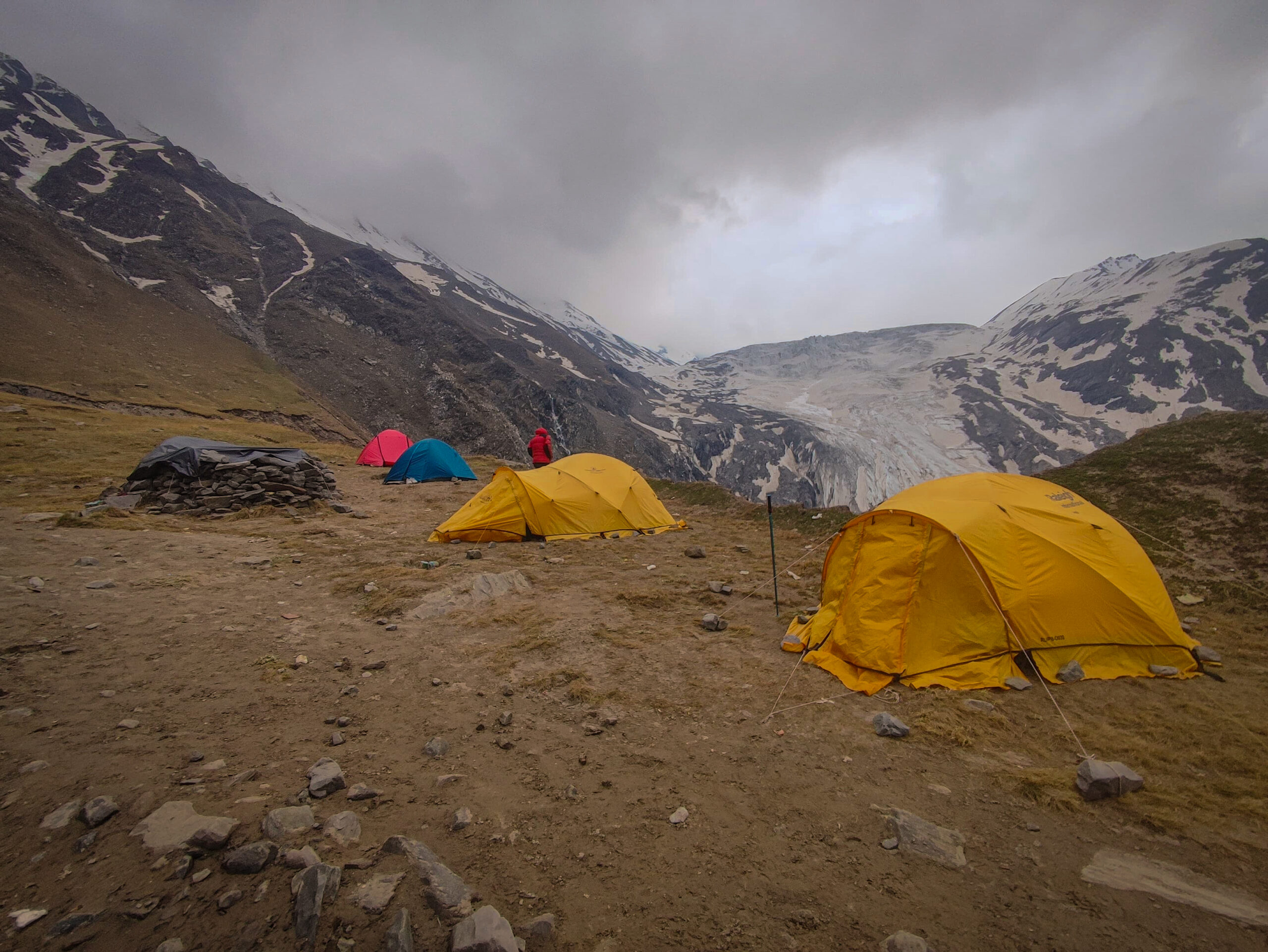
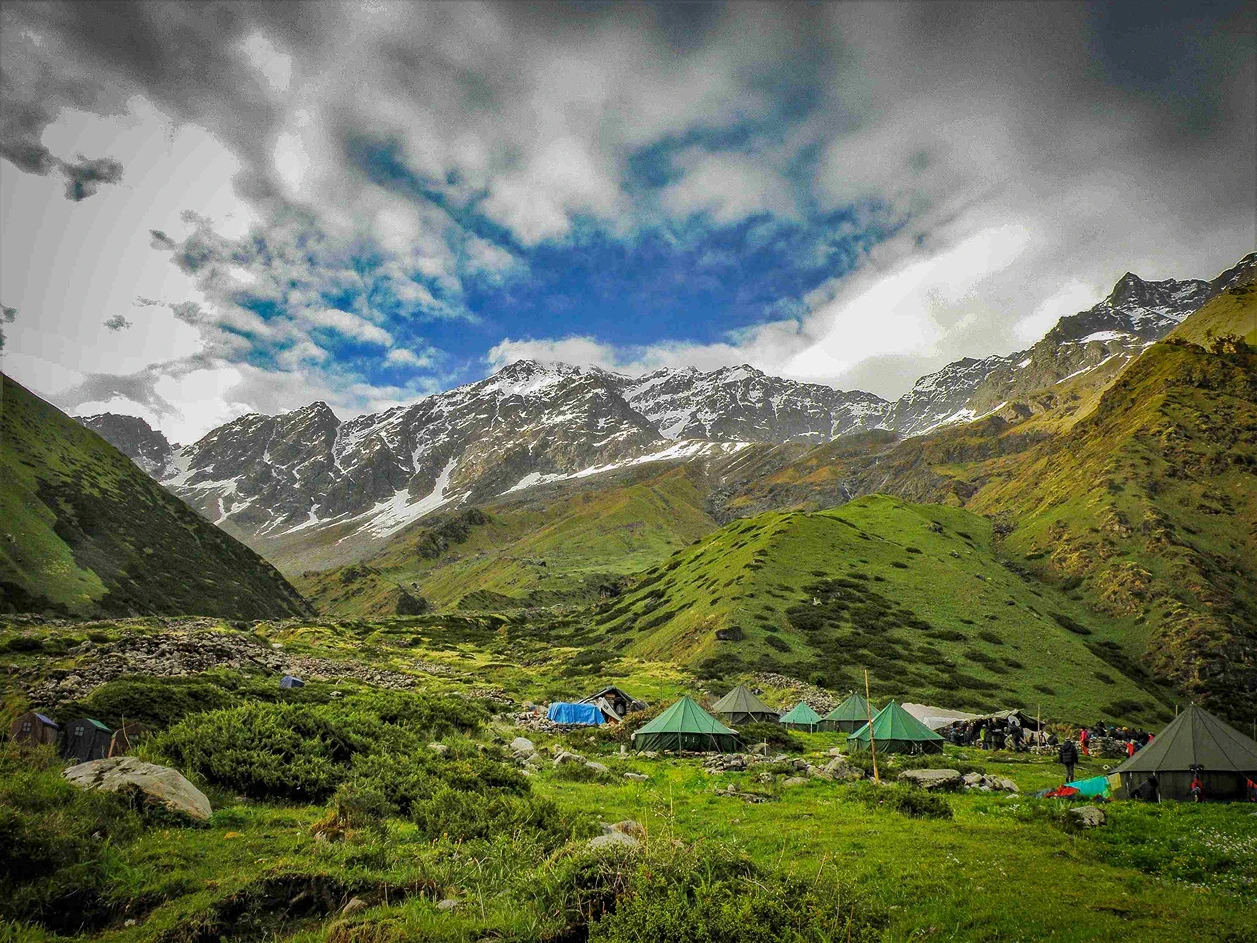
Black Peak Base Camp is generally established around the Kyarkoti area, after approaching through Ruinsara Tal.
Several route descriptions place this camp around the 3,500–3,800 m zone, although exact camp placement varies between expedition teams and seasons.
At this elevation, Base Camp does not necessarily remain continuously snow-covered during the main climbing seasons.
During a typical post-monsoon expedition, climbers may encounter a mixture of:
- Alpine grass
- Wet ground
- Rock and boulder fields
- Moraine
- Small snow patches
- Fresh snowfall after weather systems
The transition toward persistent glacier and snow terrain occurs higher on the route.
This is one reason why photographs showing a relatively snow-free Base Camp should never be interpreted as evidence that the upper mountain lacks snow.
Black Peak’s upper camps occupy a completely different climatic and glacial environment.
Base Camp Status for September 2026
As of 22 September, no reliable publicly available field measurement has been located confirming current snow depth at Kyarkoti Base Camp.
Given the continuing late-monsoon influence in Uttarkashi, teams should instead verify:
Recent precipitation: Whether the previous 48–72 hours brought rain or snow.
Night temperature: Overnight freezing can dramatically change the condition of snow and moraine.
Stream levels: Important during the approach.
Moraine stability: Rain can destabilise loose slopes.
Fresh snowfall: Even modest snowfall can cover rocks and make movement more difficult.
These observations should be recorded once expedition teams reach Base Camp.
Advance Base Camp: Where Conditions Become More Alpine
The route above Kyarkoti gradually moves away from vegetation and into moraine and glacier terrain.
Some modern route descriptions place an Advance Base Camp at approximately 15,000 ft, although expedition camp configurations differ. The route may involve loose moraine followed by increasingly continuous snow and glacier travel.
From this point onward, surface conditions become particularly important.
Climbers may encounter:
Hard morning snow: Often advantageous for movement when temperatures have dropped sufficiently overnight.
Soft afternoon snow: Solar radiation can weaken the surface considerably.
Glacial ice: More exposed after periods of snowmelt.
Fresh snow: Can hide cracks and irregularities.
Crevasses: Some visible, others potentially covered by snow bridges.
This transition is one of the reasons Black Peak should not be approached like a high-altitude trekking summit.
Camp 1 Snow and Glacier Conditions
Camp configurations vary, but the higher camps are established directly within the mountain’s glacial environment.
The route between the advance camp and higher camps requires careful glacier movement. Current route descriptions specifically identify crevasses as a major concern and recommend roped travel.
Conditions here can change substantially between the May–June and September–October seasons.
Pre-monsoon
During May and early June, the glacier generally carries more accumulated winter snow.
Potential advantages include greater snow coverage over sections of the glacier.
However, fresh or unconsolidated snow can also increase:
- Trail-breaking effort
- Avalanche concern after storms
- Difficulty identifying crevasses
- Risk associated with weak snow bridges
Post-monsoon
By September, months of summer melt can expose more glacier ice and open crevasses.
The surface may become harder, particularly after clear nights and strong radiational cooling.
This can make crampon technique increasingly important.
The trade-off is significant: harder snow may make travel more efficient, but exposed ice and open crevasses can make the route more technical.
Summit Camp Conditions
Summit Camp is generally established around the 5,400–5,500 m zone, depending on route and seasonal conditions.
At this altitude, temperatures can drop sharply after sunset.
The expedition is now operating almost entirely within a high-altitude snow-and-ice environment.
A historical route description places a high camp around 18,500 ft before climbers moved toward a roughly 19,500-ft col.
Modern itineraries similarly describe high camps around 18,000 ft before the final summit attempt.
Conditions to assess from Summit Camp include:
- Overnight refreezing
- Wind loading
- Fresh snow accumulation
- Visibility
- Cornice formation
- Glacier cracks
- Ice hardness
- Fixed-rope anchors
- Bergschrund condition
- Summit-slope stability
A clear sky alone is therefore not enough to determine whether a summit attempt is safe.
Black Peak Summit Conditions
The final climb to Black Peak is the defining section of the expedition.
Historical accounts describe steep terrain immediately below the summit, including slopes of approximately 50–60 degrees near the summit cornice during one documented ascent.
Contemporary route descriptions also identify steep snow and ice sections requiring fixed ropes, crampons and jumars.
Conditions can range from firm névé to hard ice or recently deposited snow depending on the season and preceding weather.
Hard Snow and Ice
Hard snow may provide excellent crampon purchase for competent climbers, but falls become far more serious.
Climbers must maintain:
- Secure crampon placement
- Correct ice-axe positioning
- Fixed-rope discipline
- Proper spacing
- Reliable clipping procedures
Fresh Snow
Recent snowfall may improve surface coverage but can conceal underlying hard ice or crevasses.
Wind can also redistribute fresh snow rapidly.
Wind
Wind is another major summit factor.
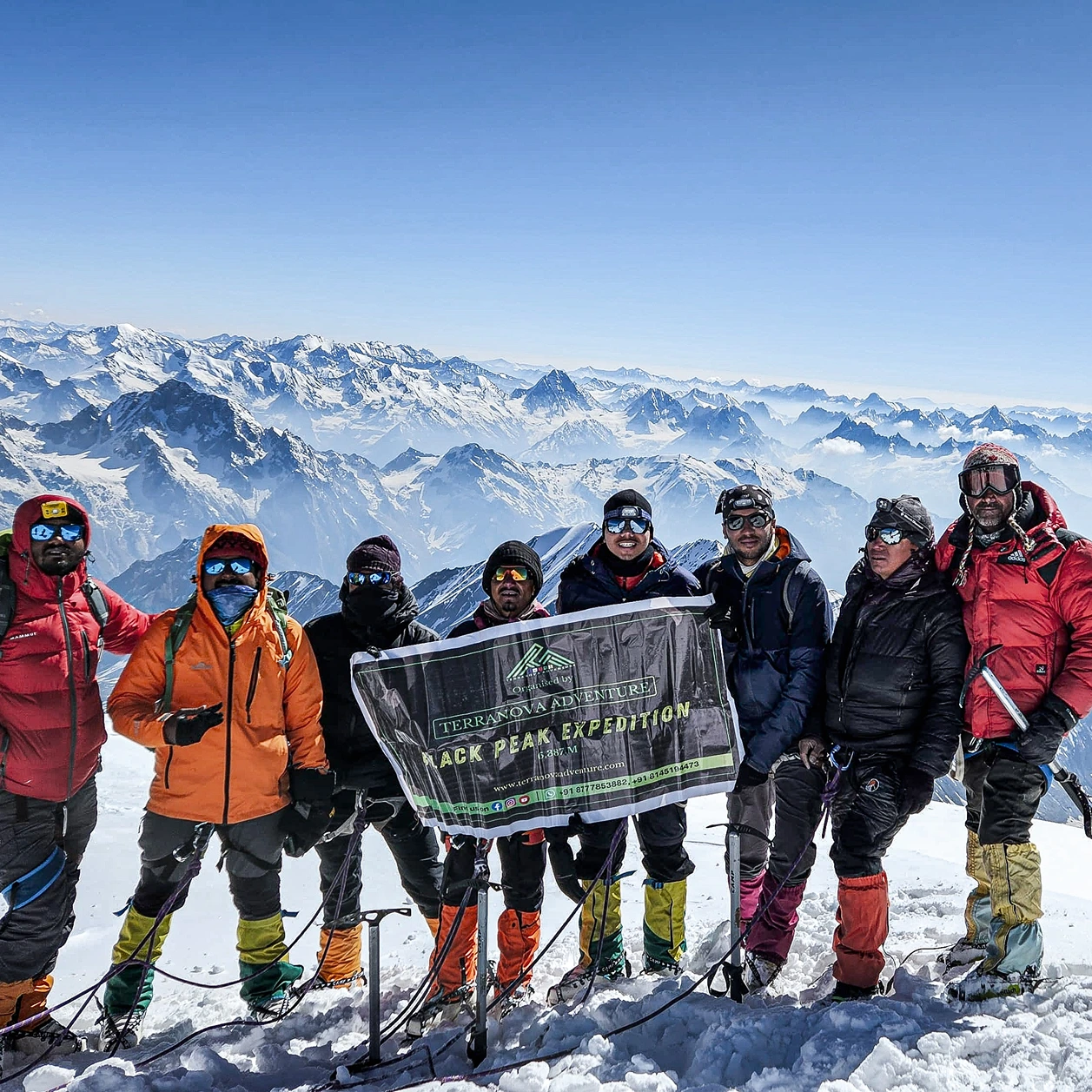
A successful September 2025 ascent reported by The Tribune described the expedition encountering temperatures around –20°C, strong icy winds and dangerous crevasses during the September 17–30 climbing period.
Those observations are useful historical context, but they should not be treated as a direct forecast for September 2026.
Why September and October Conditions Can Be Technical
Post-monsoon expeditions often attract climbers because the atmosphere can become clearer after monsoon withdrawal.
But less precipitation does not automatically mean easier climbing.
During the summer, glacier surfaces undergo substantial melting. By autumn:
- Snow bridges may become thinner
- Crevasses may become more visible
- Bare glacier ice can increase
- Snowfields can become harder
- The upper face may become icier
- Nights become progressively colder
One current Black Peak route guide specifically notes that September generally offers clearer skies but can present harder, more exposed ice compared with June.
That makes technical competence especially important during autumn attempts.
September–October 2026 Outlook
Several operators have scheduled Black Peak departures for late September 2026, demonstrating that the period remains an established commercial climbing window.
For example, one operator lists a 26 September–11 October 2026 Black Peak batch, followed by May and June 2027 departures.
Another lists a late-September 2026 expedition extending into October.
This does not guarantee suitable summit conditions.
Every expedition still depends on:
- Monsoon withdrawal
- Fresh snowfall
- Wind
- Glacier condition
- Crevasse accessibility
- Overnight freezing
- Visibility
- Team acclimatisation
- Route fixing
- A suitable summit weather window
Teams beginning in late September should therefore retain adequate contingency days.
Expected Black Peak Conditions in October 2026
October represents the later part of the post-monsoon climbing window.
As autumn progresses, nights become colder and the upper mountain can become increasingly icy.
Early October may still provide useful climbing opportunities when weather remains stable.
Later in October, however, the probability of significant cold and winter-like conditions increases.
A late-season team may encounter:
- Harder glacier surfaces
- Colder high camps
- Strong wind chill
- Increased ice exposure
- Shorter daylight
- Fresh western-disturbance snowfall
For this reason, expedition schedules should never assume that conditions seen by a team two weeks earlier will remain unchanged.
Winter 2026–27: What Happens to Black Peak?
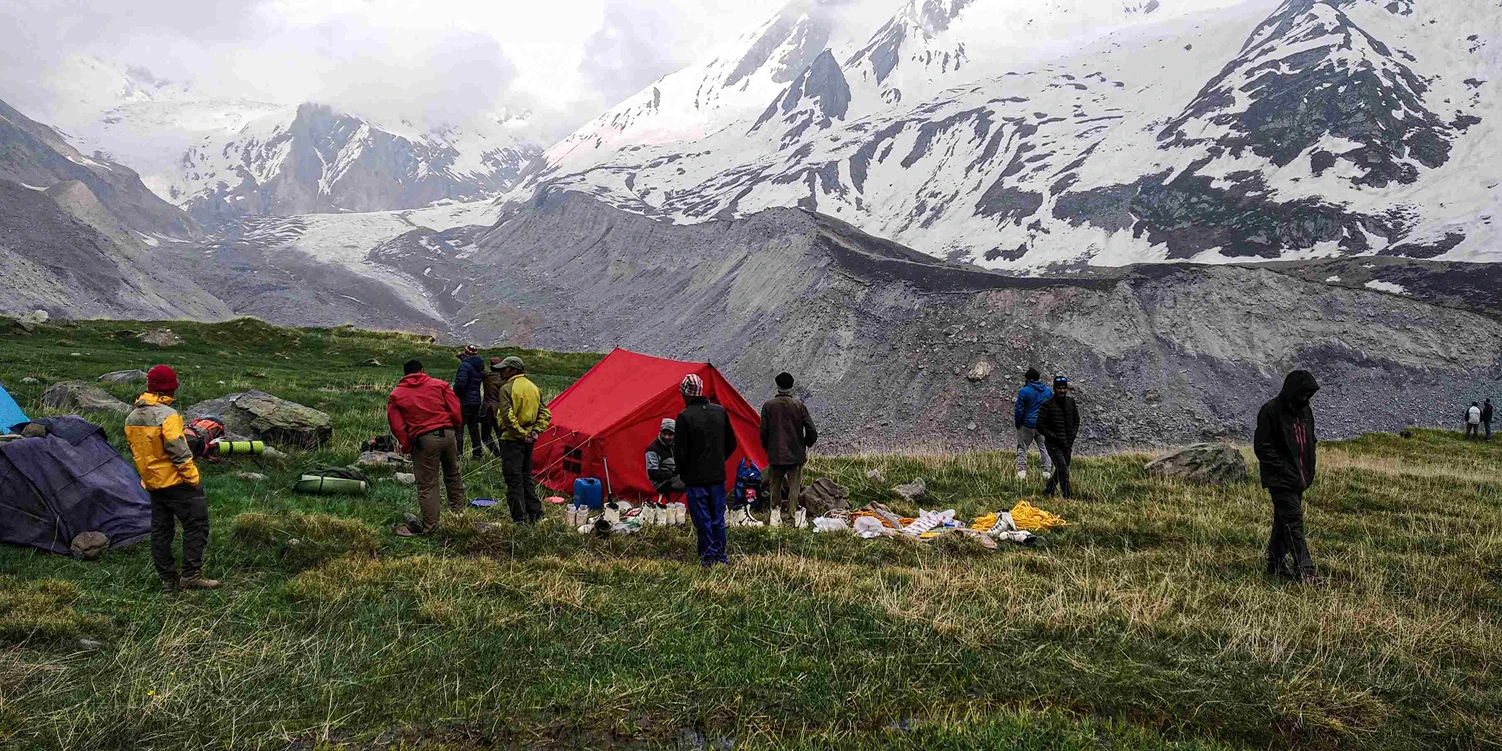
From late autumn into winter, Black Peak enters a very different environment.
Successive snowfall events replenish the glacier and cover exposed summer ice. Temperatures at high camps become severe, and access through the approach valleys can also become more complicated.
During winter, snowfall accumulates across:
- Glacier basins
- Crevasses
- Upper snowfields
- Summit slopes
- Ridges and cornices
Wind redistributes much of this snow.
Consequently, snow depth alone cannot indicate climbing safety.
A slope carrying 40 cm of wind-loaded snow can potentially be more problematic than another location containing considerably deeper but well-consolidated snow.
Winter accumulation eventually creates the snowpack encountered by climbers returning during the May–June 2027 Black Peak Expedition season.
What to Expect in May 2027
May marks the beginning of the main pre-monsoon climbing period.
Compared with autumn, climbers should generally expect substantially greater winter snow coverage across the upper mountain.
Potential conditions include:
- Snow-covered moraine at higher elevations
- Deeper glacier snow
- Partially concealed crevasses
- Strong snow bridges
- Weak snow bridges
- Softer afternoon snow
- Fresh snowfall from spring storms
- Cold summit mornings
Snow bridges deserve particular attention.
A glacier can look smoother and easier in May because winter snow covers many cracks.
But the absence of visible crevasses does not mean the glacier is safe.
Roped glacier travel remains essential.
Black Peak Conditions in June 2027
June often provides an important balance between winter snow coverage and increasingly consolidated snow.
Longer daylight and warmer temperatures can improve expedition logistics, but warming also increases afternoon snow softening.
Teams may therefore favour very early movement above the glacier camps.
As temperatures rise:
- Snow bridges can weaken
- Crevasses begin opening
- Moraine becomes increasingly exposed
- Wet-snow instability can increase
- Rockfall risk may rise on exposed terrain
Timing becomes critical.
A section that feels firm and secure at 5:00 AM can become considerably softer several hours later.
2026–27 Black Peak Seasonal Condition Tracker
September 2026
Current phase: Late monsoon transitioning toward post-monsoon.
Regional Uttarkashi weather has remained unsettled, with rain and thunderstorm possibilities continuing into late September.
Primary concerns: Wet approach, road disruption, cloud, fresh high-altitude precipitation, glacier condition.
October 2026
Expected phase: Post-monsoon transitioning toward early winter.
Typical concerns: Hard ice, colder nights, strong winds and fresh snowfall later in the month.
November 2026–March 2027
Expected phase: Winter accumulation.
Typical concerns: Deep snow, severe cold, wind loading, avalanche conditions and difficult access.
April 2027
Expected phase: Spring transition.
Winter snow remains extensive at altitude while daytime heating begins increasing.
May 2027
Expected phase: Early pre-monsoon expedition season.
Expect significant winter snow coverage and potentially concealed crevasses.
June 2027
Expected phase: Established pre-monsoon climbing season.
Snow becomes increasingly consolidated, but warming progressively affects glacier and snow-bridge stability.
Black Peak Expedition vs a Normal Himalayan Trek
Black Peak should not be confused with popular high-altitude treks.
The expedition reaches nearly 6,400 metres and requires climbers to operate on a glacier and steep snow/ice terrain.
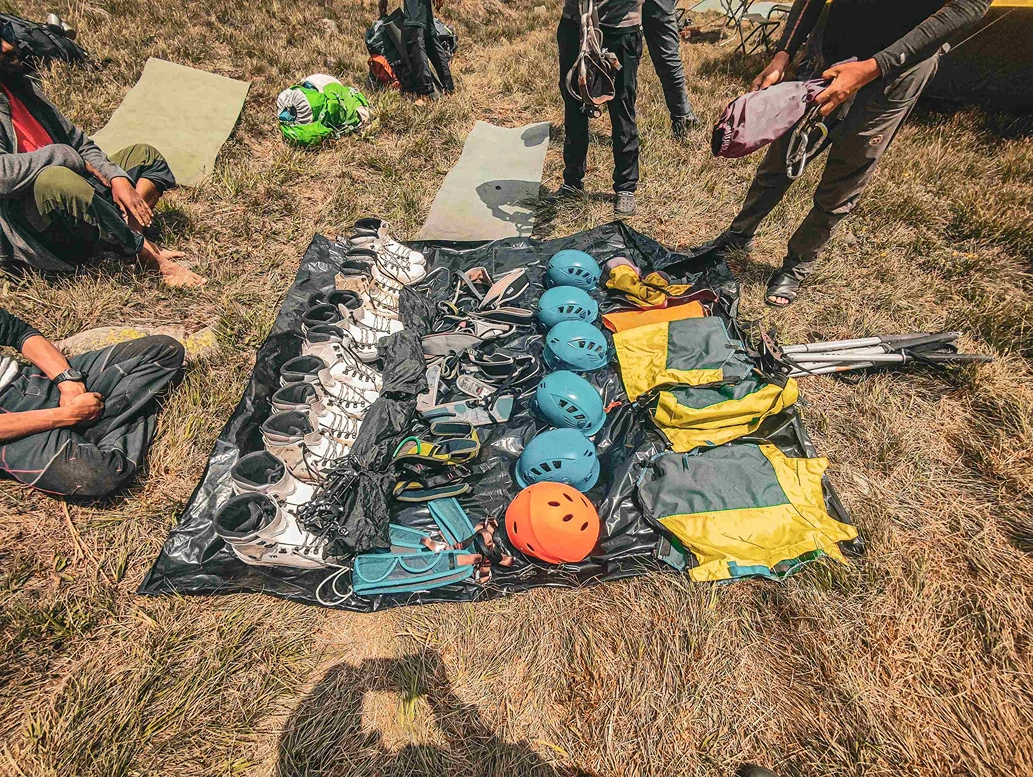
Experience with equipment such as the following is highly valuable:
- Mountaineering boots
- Crampons
- Ice axe
- Harness
- Helmet
- Ascender/Jumar
- Descender
- Carabiners
- Fixed ropes
- Glacier rope systems
Participants should understand how to walk safely with crampons, arrest a fall, move on fixed lines and manage themselves at altitude.
Black Peak is therefore better regarded as a mountaineering objective than simply a more difficult trek.
How Snow Conditions Affect Summit Success
Weather and snow conditions interact with almost every part of the climb.
Deep Snow
Deep unconsolidated snow dramatically increases energy expenditure.
At 5,500–6,000 metres, even moderate trail breaking can become exhausting.
Hard Ice
Hard ice reduces trail-breaking effort but increases technical difficulty and consequences of a fall.
Fresh Snow Over Ice
This can create deceptive footing because crampons may not immediately penetrate to the harder layer below.
Weak Snow Bridges
These increase crevasse risk.
Strong Wind
Wind can erase tracks, transport snow and create dangerous wind slabs.
Poor Overnight Freeze
If temperatures remain relatively warm overnight, climbers may begin the summit attempt on softer snow than expected.
For this reason, summit decisions should be based on observations made by the expedition leadership rather than a general internet weather forecast.
Black Peak Expedition Preparation for 2026–27
Anyone considering Black Peak among their Upcoming Himalayan Expeditions should prepare for more than altitude.
A strong training programme should combine cardiovascular endurance, leg strength, loaded carries and long-duration mountain movement.
Climbers should ideally arrive comfortable with:
- Crampon walking
- Ice-axe handling
- Fixed-rope ascent
- Jumar use
- Rappelling
- Rope clipping
- Glacier travel
- Self-arrest fundamentals
Physical preparation should begin several months before departure rather than relying on general fitness.
A climber may be strong enough to trek for eight hours but still struggle when carrying equipment above 5,000 metres while wearing mountaineering boots and crampons.
Black Peak Among Upcoming Himalayan Expeditions 2026–27
For climbers planning Upcoming Himalayan Expeditions, Black Peak occupies an interesting position.
It provides exposure to several elements associated with larger expeditions:
- Multi-camp climbing
- Load ferries
- Glacier movement
- Technical equipment
- High-altitude acclimatisation
- Fixed ropes
- Summit-night climbing
- Weather-window decisions
This makes the expedition particularly relevant for mountaineers progressing toward more technically demanding or higher Himalayan objectives.
However, the summit should never be treated as guaranteed.
Mountain conditions ultimately determine whether the team moves upward, waits or turns around.
How Climbers Should Use This Black Peak Snow Report
Snow reports are most useful when treated as planning documents rather than guarantees.
Before departure, monitor regional weather and access.
At Sankri, obtain recent information from guides and teams returning from the valley.
At Base Camp, begin recording actual mountain observations.
Useful observations include:
Fresh snow in previous 24 hours
Approximate snow depth
Minimum overnight temperature
Wind direction and strength
Cloud development
Glacier condition
Crevasse visibility
Snow-bridge condition
Fixed-rope status
Summit-slope condition
These field observations are considerably more valuable than relying solely on a city-level forecast.
Final Update: Black Peak Snow Conditions 2026–27
As of 22 September 2026, Black Peak is approaching its main post-monsoon climbing window, but Uttarkashi has continued to experience late-monsoon rainfall and unsettled weather. IMD forecasts around this period still show possibilities of rain and thunderstorms in Uttarkashi.
At the same time, expedition departures are scheduled for late September and early October, meaning route-opening teams should soon provide a much clearer picture of conditions at Kyarkoti, the glacier camps and the upper summit slopes.
The key distinction is that regional weather is currently verifiable, but precise Black Peak snow depths are not.
Until direct field observations become available, climbers should avoid relying on unverified claims about exact snow depth, crevasse coverage or summit ice.
For anyone planning a Black Peak Expedition or researching Upcoming Himalayan Expeditions, the most valuable updates will come from teams physically moving through the route during late September and early October 2026.
This page can therefore function as a continuing Black Peak Snow Report 2026–27, with field observations added throughout the autumn 2026 and spring 2027 climbing seasons.
FAQs — Black Peak Snow Report 2026–27
1. Is there snow on Black Peak throughout the year?
Snow and glacier ice remain on the upper mountain throughout the year, although the amount of seasonal snow covering the glacier and upper slopes changes considerably between spring, summer and autumn.
2. What are the current Black Peak snow conditions in September 2026?
As of 22 September 2026, reliable public field measurements from the upper Black Peak camps are limited. Uttarkashi has experienced late-monsoon rainfall and unsettled conditions, but exact snow depth at Black Peak should be verified by expedition teams on the mountain.
3. What is the best time for the Black Peak Expedition?
The main climbing windows are generally May–June and September–October. Each has different snow and glacier characteristics.
4. Is Black Peak easier in May or September?
Neither season is automatically easier. May generally has greater winter snow coverage, while September can expose harder glacier ice and more open crevasses. Actual difficulty depends on that season’s snowpack and weather.
5. How high is Black Peak?
Black Peak, or Kalanag, rises to approximately 6,387 metres (20,955 ft) in the Garhwal Himalayas.
6. Is Black Peak a technical expedition?
Yes. The normal route involves glacier travel, crevasses, fixed ropes and steep snow/ice climbing. Participants should have appropriate mountaineering preparation.
7. Does Black Peak have crevasses?
Yes. Glacier travel forms an important part of the expedition, and crevasses are one of the major hazards between the higher camps.
8. How cold does Black Peak get during the summit attempt?
Temperatures can fall well below freezing, with wind chill making conditions substantially colder. A September 2025 expedition reported temperatures around –20°C along with strong icy winds. Conditions vary by season and weather window.
9. Will Black Peak have more snow in May 2027?
Typically, May carries considerably more residual winter snow than the post-monsoon period. The actual 2027 snowpack, however, will depend on winter 2026–27 snowfall and spring temperatures.
10. When will the next Black Peak snow report be useful?
The next major update should come after late-September/October 2026 expedition teams reach Base Camp and the upper glacier. Reports containing dated photographs, snow depth, glacier observations and summit conditions will provide much stronger evidence than regional forecasts alone.
11. Is September a good month for Black Peak Expedition?
September is an established post-monsoon climbing window. Later September generally coincides with improving weather, but monsoon withdrawal varies from year to year. In 2026, unsettled weather persisted in Uttarkashi into late September.
12. What conditions should climbers check before attempting Black Peak?
Climbers should evaluate recent snowfall, overnight freezing, wind, visibility, glacier conditions, crevasses, snow bridges, fixed-rope condition and the summit weather window before moving to the upper camps.
13. Is Black Peak suitable for beginners?
It should not be treated as a beginner trek. Black Peak involves expedition-style climbing and technical snow/glacier terrain. Previous high-altitude experience and mountaineering skills are strongly recommended.
14. Why is Black Peak popular among Upcoming Himalayan Expeditions?
Black Peak combines a 6,000-metre summit with glacier travel, high camps, fixed ropes and technical snow climbing. It therefore offers a substantial progression from trekking into expedition mountaineering.
15. Where does the Black Peak Expedition start?
Most commercial itineraries begin from Sankri in Uttarkashi, proceeding through the Ruinsara Valley toward Kyarkoti Base Camp before entering the glacier and high-camp section of the expedition.