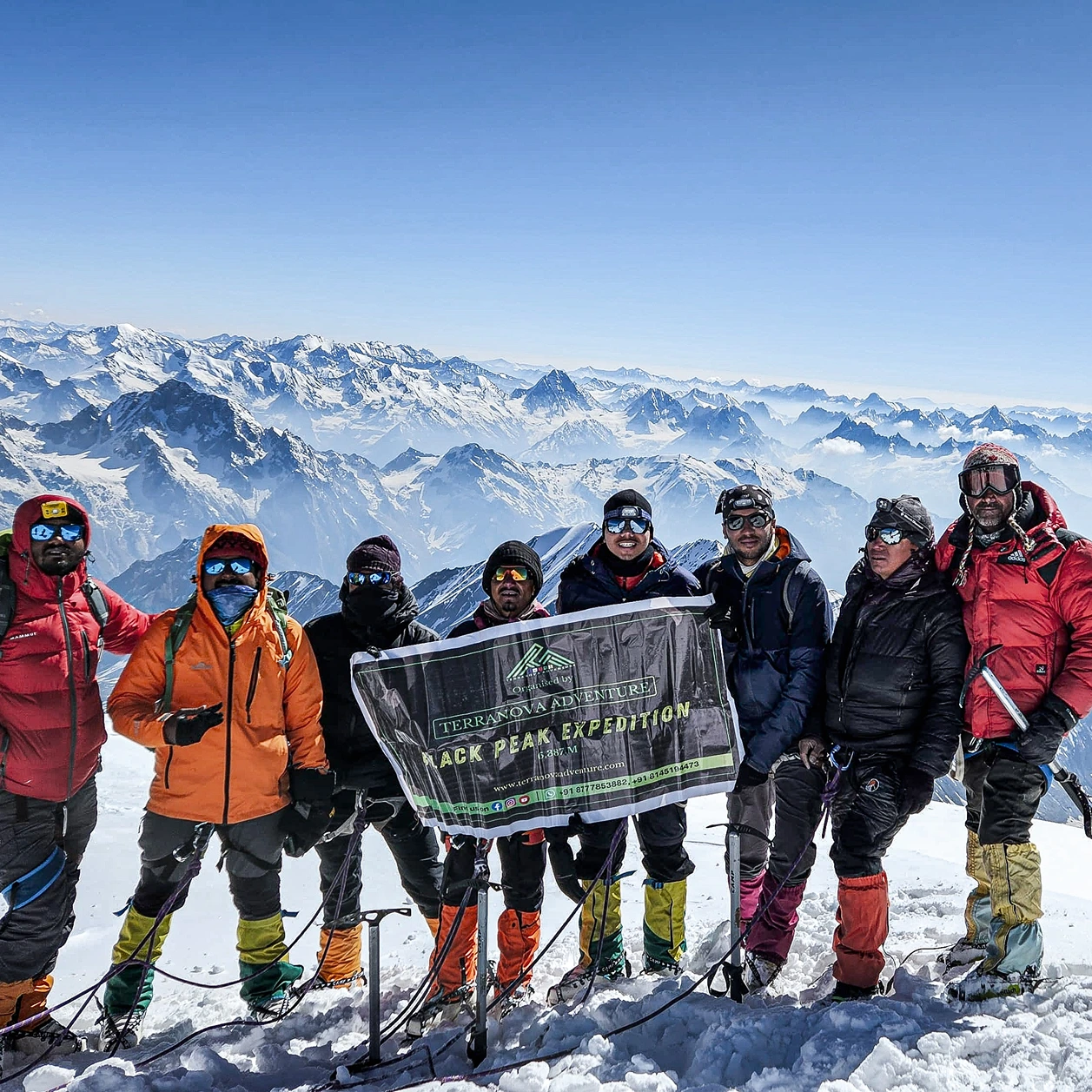
Rising to 6,387 metres (20,955 ft), Black Peak (Kalanag) is the highest summit of the Bandarpunch massif in the Garhwal Himalayas of Uttarakhand. Named after its striking resemblance to the raised hood of a black cobra, this iconic mountain has become one of India’s most respected high-altitude expeditions. Unlike trekking peaks, Black Peak is a true mountaineering objective that demands technical climbing skills, glacier travel experience, and exceptional physical endurance.
The journey begins from Sankri, passing through the ancient village of Osla, the pristine meadows of Ruinsara Tal, and finally reaching Kyarkoti Base Camp, nestled beneath towering Himalayan giants. Along the approach, climbers traverse dense forests, alpine grasslands, moraines, glaciers, and snowfields while enjoying spectacular views of Swargarohini, Bandarpunch, and surrounding Garhwal peaks. Every stage of the expedition serves as an essential part of the acclimatization process before the technical summit climb begins.
Above Base Camp, the terrain changes dramatically. Climbers encounter crevasse-prone glaciers, steep snow slopes, exposed ridges, and fixed-rope sections that require confident use of mountaineering equipment such as crampons, ice axes, harnesses, and ascenders. Summit day is physically demanding, often lasting 12–16 hours, making Black Peak an ideal objective for experienced climbers preparing for larger Himalayan expeditions.
At Terranova Expeditions, our Black Peak Expedition is carefully designed with a strong emphasis on gradual acclimatization, structured load-ferry rotations, technical training, and weather-based decision making. Our experienced expedition leaders prioritize safety over speed, allowing climbers to adapt to the altitude while maximizing summit success. Every camp, movement, and climbing day follows a systematic expedition strategy developed from years of Himalayan mountaineering experience.
More than simply reaching a 6,000-metre summit, the Black Peak Expedition is an immersive Himalayan experience that tests endurance, technical ability, teamwork, and mental resilience. For mountaineers seeking a serious alpine challenge in India, Black Peak stands as one of the finest and most rewarding expeditions in the Garhwal Himalayas.
1. Where is Black Peak located?
Black Peak, also known as Kalanag, is located in the Govind Pashu Vihar National Park in Uttarkashi district, Uttarakhand. Standing at 6,387 metres (20,955 ft), it is the highest peak in the Bandarpunch massif and one of India’s most sought-after mountaineering expeditions.
2. Why is Black Peak called Kalanag?
The summit resembles the raised hood of a black cobra when viewed from certain angles. Because of this distinctive shape, locals named it Kalanag, which translates to Black Cobra.
3. How difficult is the Black Peak Expedition?
Black Peak is considered a technical expedition and is graded Difficult to Challenging. Climbers must negotiate glaciers, crevasses, steep snow slopes, and mixed terrain. Prior experience on at least one 5,500–6,000 m expedition is strongly recommended.
4. Can beginners attempt Black Peak?
No. Black Peak is not suitable for beginners. It requires previous high-altitude trekking or mountaineering experience along with knowledge of basic technical equipment like crampons, ice axe, harness, and fixed rope techniques.
5. What is the altitude of Black Peak?
Black Peak stands at 6,387 metres (20,955 feet) above sea level, making it one of the highest trekking-accessible expedition peaks in Uttarakhand.
6. What is the best time to climb Black Peak?
The best climbing seasons are:
- May to June (Pre-Monsoon)
- September to October (Post-Monsoon)
These months generally offer more stable weather, better visibility, and safer glacier conditions.
7. How many days are required for the Black Peak Expedition?
A standard Black Peak expedition usually takes 13 to 16 days, including approach trek, acclimatization, load ferry, summit push, contingency days, and return.
8. What fitness level is required?
You should be capable of:
- Running 5–10 km comfortably
- Carrying a loaded backpack
- Trekking for 8–10 hours daily
- Training consistently for at least 8–12 weeks before the expedition
Strong cardiovascular endurance and leg strength are essential.
9. Is Black Peak a technical climb?
Yes. Unlike normal Himalayan treks, Black Peak involves technical mountaineering sections that require:
- Ice axe
- Crampons
- Fixed rope climbing
- Snow and glacier travel
- Rope team movement
10. Do I need mountaineering experience?
Yes. Previous experience on high-altitude expeditions significantly improves both safety and summit success. Many operators recommend completing a basic mountaineering course or at least a 6,000 m non-technical peak before attempting Black Peak.
11. Is there a risk of altitude sickness?
Yes. Since the expedition exceeds 6,000 metres, Acute Mountain Sickness (AMS) is a genuine risk. Proper acclimatization, hydration, gradual ascent, and following the expedition leader’s instructions are essential.
12. Which permits are required for Black Peak?
The expedition requires forest permits, expedition permits, and local administrative permissions. These are usually arranged by the organizing expedition company.
13. What is the summit day like?
Summit day usually begins around midnight or early morning and can last 12–16 hours. Climbers ascend through snow slopes and glacier terrain before reaching the summit and descending safely back to camp.
14. What kind of accommodation is available?
Accommodation generally includes:
- Guesthouses or homestays at Sankri
- Alpine tents at higher camps
- Expedition camps at Base Camp and Summit Camp
Facilities become increasingly basic with altitude.
15. Is mobile network available during the expedition?
Mobile connectivity is generally available only until Sankri. Beyond that, network coverage is extremely limited or unavailable.
16. What equipment is required?
Essential equipment includes:
- Double-layer trekking boots
- Crampons
- Ice axe
- Harness
- Helmet
- Down jacket
- Waterproof shell
- Glacier sunglasses
- Sleeping bag
- Trekking poles
- Headlamp
Most technical gear is often provided by expedition organizers, but confirm before booking.
17. What are the chances of reaching the summit?
Summit success depends on:
- Weather conditions
- Proper acclimatization
- Physical fitness
- Technical ability
- Team decision-making
No responsible operator guarantees a summit because safety always takes priority.
18. How cold does it get on Black Peak?
Temperatures can drop to -15°C to -25°C during summit nights, with even lower wind-chill values.
19. What is the route for the Black Peak Expedition?
The standard route is:
Dehradun → Sankri → Taluka → Osla → Ruinsara Tal → Kyarkoti Base Camp → Advance Camp → Summit Camp → Black Peak Summit → Return
20. Which is better: Black Peak or Friendship Peak?
Both are excellent expeditions but differ significantly.
- Friendship Peak (5,289 m): Semi-technical, suitable as a first expedition.
- Black Peak (6,387 m): Technical, longer, higher, and more demanding with glacier travel and advanced mountaineering skills.
Black Peak is generally recommended only after completing a lower-altitude expedition successfully.