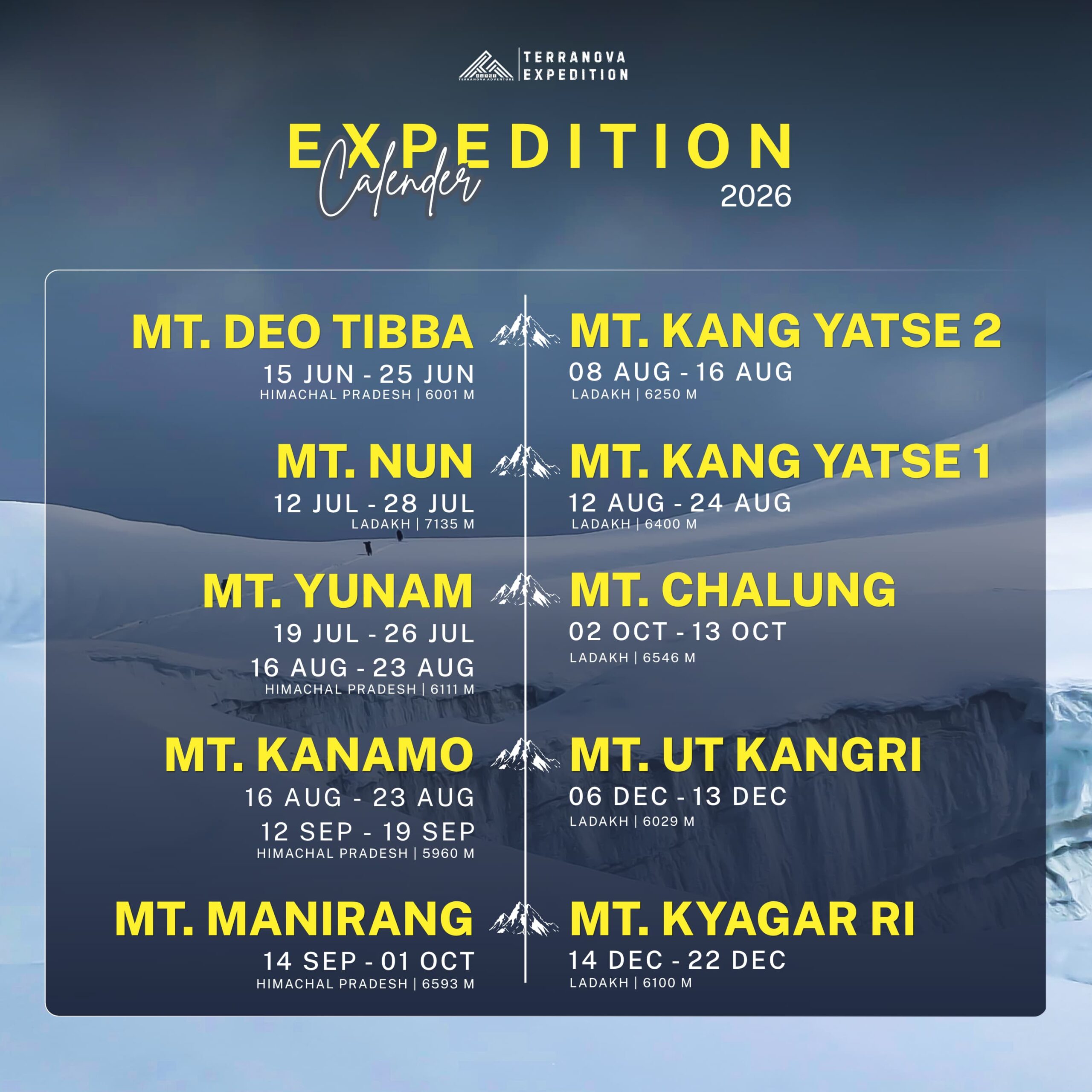
The Indian Himalayas offer one of the most diverse mountaineering landscapes in the world. From accessible 6,000-metre peaks in Ladakh and Himachal Pradesh to technical glacier expeditions in Uttarakhand, climbers can progress through dramatically different terrain without leaving the Indian Himalayan range.
But choosing a peak is only half the decision.
Choosing the right month can determine whether an expedition takes place on stable snow, exposed scree, an active glacier or under an approaching monsoon system. Road access, snowfall, acclimatization, temperature, river conditions and local weather patterns all influence when a Himalayan peak should be attempted.
For mountaineers planning ahead, the Indian Himalayan Expedition Calendar 2027 provides a practical month-by-month framework for choosing the right objective.
This guide focuses particularly on five important expedition peaks:
- Black Peak
- Yunam Peak
- Friendship Peak
- Kang Yatse 1
- Kang Yatse 2
Together, these mountains represent a useful progression through the Indian Himalayas—from first 6,000-metre expeditions to significantly more technical mountaineering objectives.
Understanding the Indian Himalayan Climbing Season
There is no single climbing season that applies to the entire Indian Himalayan region.
This is one of the most important things to understand before planning an expedition.
The Himalayas extend across multiple climatic zones. A mountain in Uttarakhand may have its strongest climbing window before the monsoon, while a peak in Ladakh can be at its most accessible during July and August.
Broadly, the expedition calendar can be divided into three major periods.
Pre-Monsoon: May to June
Late spring and early summer create an important mountaineering window in Himachal Pradesh and Uttarakhand.
Snow remains at altitude, access roads reopen progressively, and teams can attempt several peaks before the main monsoon reaches the central and western Himalayas.
Monsoon / Trans-Himalayan Season: July to August
July and August are generally problematic for many expeditions in Uttarakhand and Himachal because of rain, unstable slopes, cloud cover and difficult road conditions.
Ladakh is different.
Its location in the rain shadow of the Himalayas makes this one of the strongest periods for expeditions around Leh, Markha Valley and other parts of the Ladakh range.
This is why Kang Yatse 1 Expedition and Kang Yatse 2 Expedition become particularly important summer expedition objectives.
Post-Monsoon: September to October
After the monsoon withdraws, the mountains often enter another major expedition window.
Visibility can improve substantially, precipitation decreases and many routes become more stable.
September is particularly useful because it can provide viable conditions in Ladakh, Himachal and Uttarakhand, depending on the peak.
By October, however, temperatures begin falling rapidly and early winter systems become increasingly relevant.
Indian Himalayan Expedition Calendar 2027 at a Glance
| Peak | Approx. Altitude | Region | Recommended Season | Technical Level |
| Friendship Peak | 5,289 m | Himachal Pradesh | May–June & Sep–Oct | Moderate |
| Yunam Peak | 6,111 m | Himachal Pradesh | June–September | Moderate / High Altitude |
| Kang Yatse 2 | 6,250 m | Ladakh | July–September | Moderate Expedition |
| Black Peak | 6,387 m | Uttarakhand | May–June & Sep–Oct | Technical |
| Kang Yatse 1 | 6,400 m+ | Ladakh | July–September | Technical |
These windows are planning guidelines rather than guarantees. Himalayan weather, snow conditions and local access can vary from year to year.
January 2027 – Preparation, Not Peak Season
For the expeditions covered in this guide, January is generally not the primary climbing month.
High camps experience severe winter conditions, many approach routes are buried under snow and several high-altitude roads are inaccessible.
But January can still be an important month in an expedition calendar.
This is when a climber targeting a May, June or July expedition should begin structured physical preparation.
January Training Priorities
Focus on:
- Cardiovascular endurance
- Lower-body strength
- Core stability
- Stair climbing
- Long-duration walking
- Backpack conditioning
- Mobility and recovery
For technical objectives such as Black Peak Expedition or Kang Yatse 1 Expedition, this is also the time to refresh mountaineering skills.
Your preparation should eventually cover crampon movement, rope systems, glacier travel, self-arrest principles and equipment familiarity appropriate to the intended expedition.
A 6,000-metre expedition should begin months before you reach Base Camp.
February 2027 – Build Your Expedition Foundation
February remains outside the normal climbing window for these peaks, but it is an excellent month for building expedition-specific endurance.
If your objective is a May or June climb, training volume should now become more structured.
Instead of focusing purely on gym fitness, introduce longer outdoor sessions.
Walk or hike on consecutive days when possible.
This teaches the body to recover while still working—a requirement that becomes important on expedition, where you may spend multiple days trekking, carrying loads and acclimatizing before summit day.
For climbers considering Black Peak, February is also a sensible time to assess whether their technical experience matches the objective.
Black Peak is not simply a high-altitude trek with a summit at the end.
It involves genuine mountaineering terrain.
March 2027 – Finalise Your Peak
By March, climbers targeting the pre-monsoon season should know exactly which mountain they intend to attempt.
This is the point where training, equipment and acclimatization strategy should become peak-specific.
A Friendship Peak expedition requires a different preparation level from Black Peak.
Similarly, Kang Yatse 2 and Kang Yatse 1 may share the same massif, but they should not be treated as equivalent climbs.
This is also the time to confirm expedition permissions and administrative requirements applicable to your chosen objective.
For regulated mountaineering expeditions in India, requirements can involve the Indian Mountaineering Foundation (IMF) and other local authorities. International expedition teams in particular should begin the process well in advance.
April 2027 – Transition Toward the Climbing Season
April is a transitional month.
Winter snow still dominates high elevations, while lower valleys begin reopening.
For most of the peaks discussed here, April is better considered a preparation and approach-season month rather than the default summit window.
Climbers targeting May should now be close to expedition fitness.
That means being comfortable with:
- 6–8 hours of sustained mountain movement
- Back-to-back hiking days
- Significant elevation gain
- Carrying an expedition backpack
- Cold-weather layering
- Basic technical equipment
This is also the time for a complete gear inspection.
Never discover at Base Camp that your crampons do not fit your boots.
May 2027 – Friendship Peak and Black Peak Season Begins
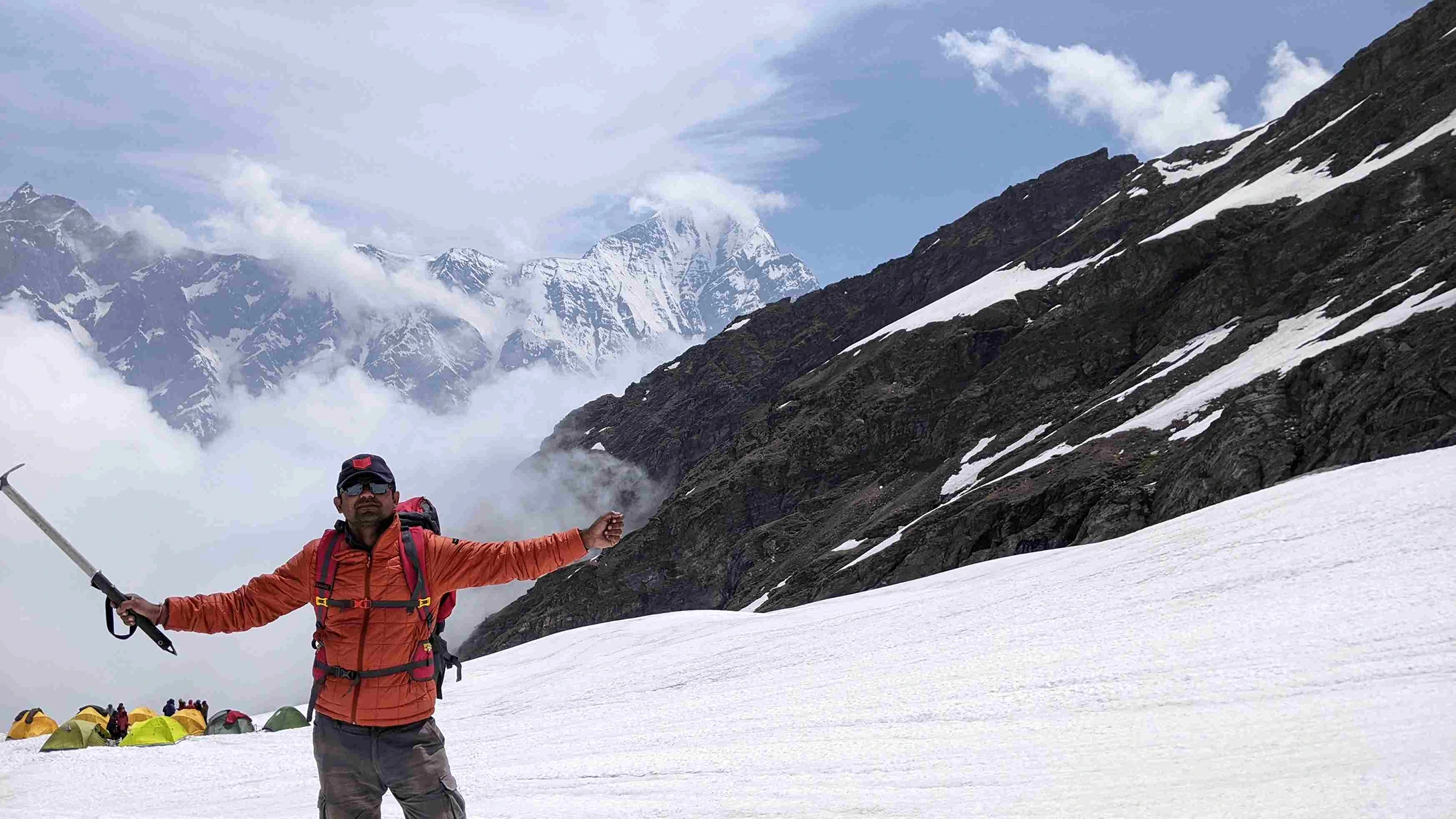
May marks the beginning of one of the most important pre-monsoon climbing periods in the Indian Himalayas.
Two objectives become particularly relevant: Friendship Peak Expedition in Himachal Pradesh and Black Peak in Uttarakhand.
Friendship Peak – A Strong Introduction to Himalayan Mountaineering
Friendship Peak, approximately 5,289 metres, rises in the Pir Panjal range near Manali.
Its altitude is lower than the other major peaks in this guide, but that does not make it a casual trek.
Depending on seasonal conditions, the climb can involve snow slopes, crampon use and rope work. The summit push requires good physical conditioning and confidence moving in a mountain environment.
Why Attempt Friendship Peak?
Friendship Peak can work as a bridge between trekking and higher mountaineering.
A climber who has completed high-altitude treks and wants to progress towards 6,000-metre expeditions may find it a logical next step.
The approach through the Manali region also makes the expedition comparatively accessible.
Best Months for Friendship Peak
The strongest windows are generally:
May–June
and
September–October
Conditions vary considerably between early summer and autumn.
In May and early June, snow coverage can be more extensive.
Post-monsoon expeditions may encounter a different combination of snow, ice and exposed terrain.
Who Should Attempt Friendship Peak?
It can suit climbers who:
- Have completed several high-altitude treks
- Possess strong cardiovascular fitness
- Want their first mountaineering-oriented summit
- Are ready to learn or apply basic snow skills
- Want to progress towards 6,000-metre Himalayan expeditions
Black Peak – A Serious Garhwal Himalayan Expedition
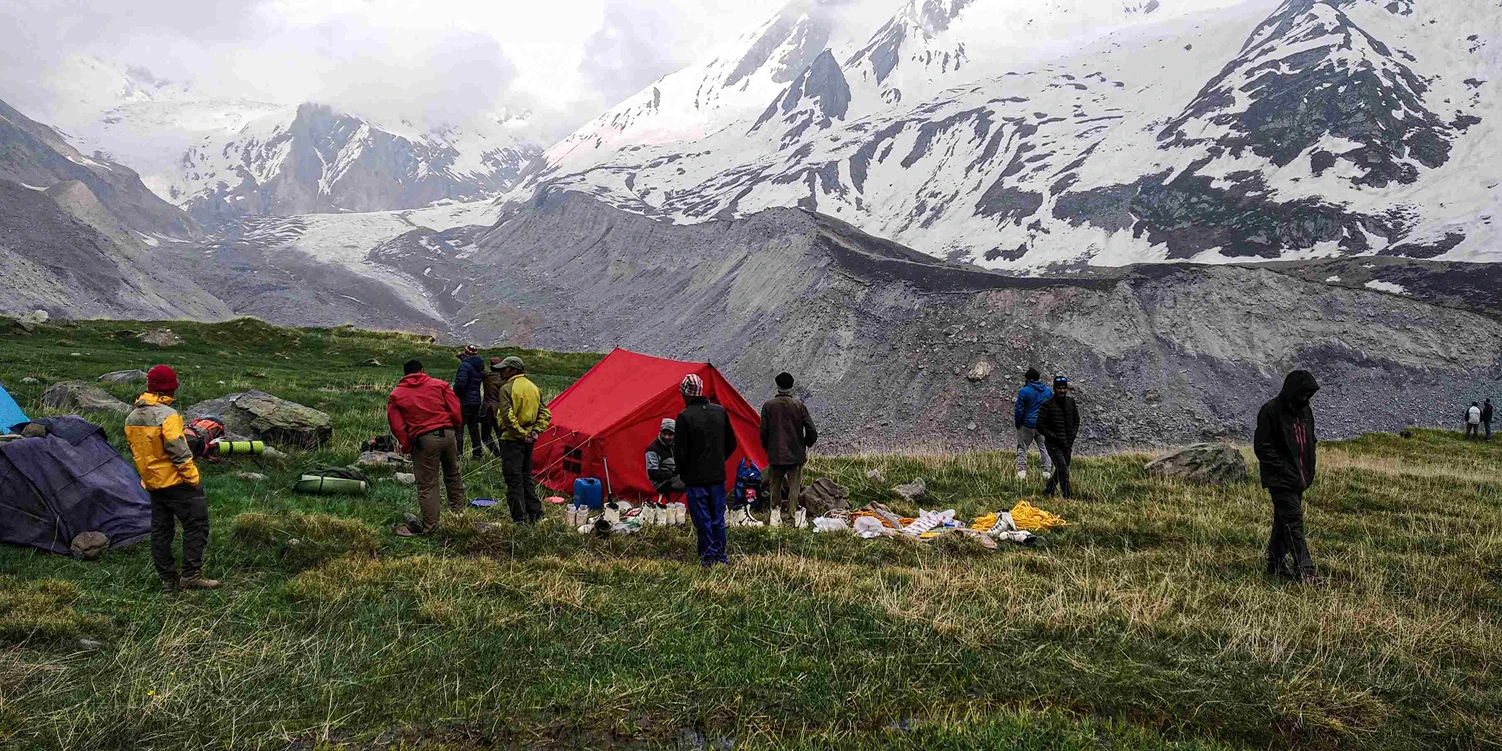
Black Peak, also known as Kalanag, rises to approximately 6,387 metres in Uttarakhand.
It belongs to the Bandarpunch massif in the Garhwal Himalayas and is a significantly more serious mountaineering objective than a standard trekking peak.
The expedition is commonly approached through the Har Ki Dun and Ruinsara Tal side of the region before moving towards glacier terrain and higher camps.
What Makes Black Peak Different?
Altitude alone does not define expedition difficulty.
Black Peak requires teams to deal with:
- Glacier travel
- Snow and ice
- Crevasse risk
- Fixed-rope sections where required
- High-altitude camps
- Long summit-day movement
- Rapidly changing mountain weather
This makes the Black Peak expedition an important progression peak for climbers who already possess high-altitude and technical experience.
Best Time for Black Peak
Two principal periods are generally considered:
Pre-monsoon: May to June
Post-monsoon: September to October
The monsoon months are generally avoided because weather and approach conditions can deteriorate substantially.
Is Black Peak Suitable for Beginners?
Not in the same way as a trekking peak.
A strong trekker may eventually progress to Black Peak, but previous experience with technical mountaineering equipment and high-altitude environments is strongly advisable.
Black Peak should be approached as an expedition—not as an extended trek.
June 2027 – One of the Most Versatile Expedition Months
June is a major month in the Indian Himalayan expedition calendar.
Depending on local conditions, climbers may consider:
- Friendship Peak
- Black Peak
- Yunam Peak
As June progresses, the weather equation becomes increasingly important because the monsoon begins affecting parts of the Himalayas.
This makes expedition timing critical.
Early and mid-June can offer useful conditions on some routes, while late-June weather can become less predictable.
Yunam Peak – Your Entry into the 6,000-Metre Zone
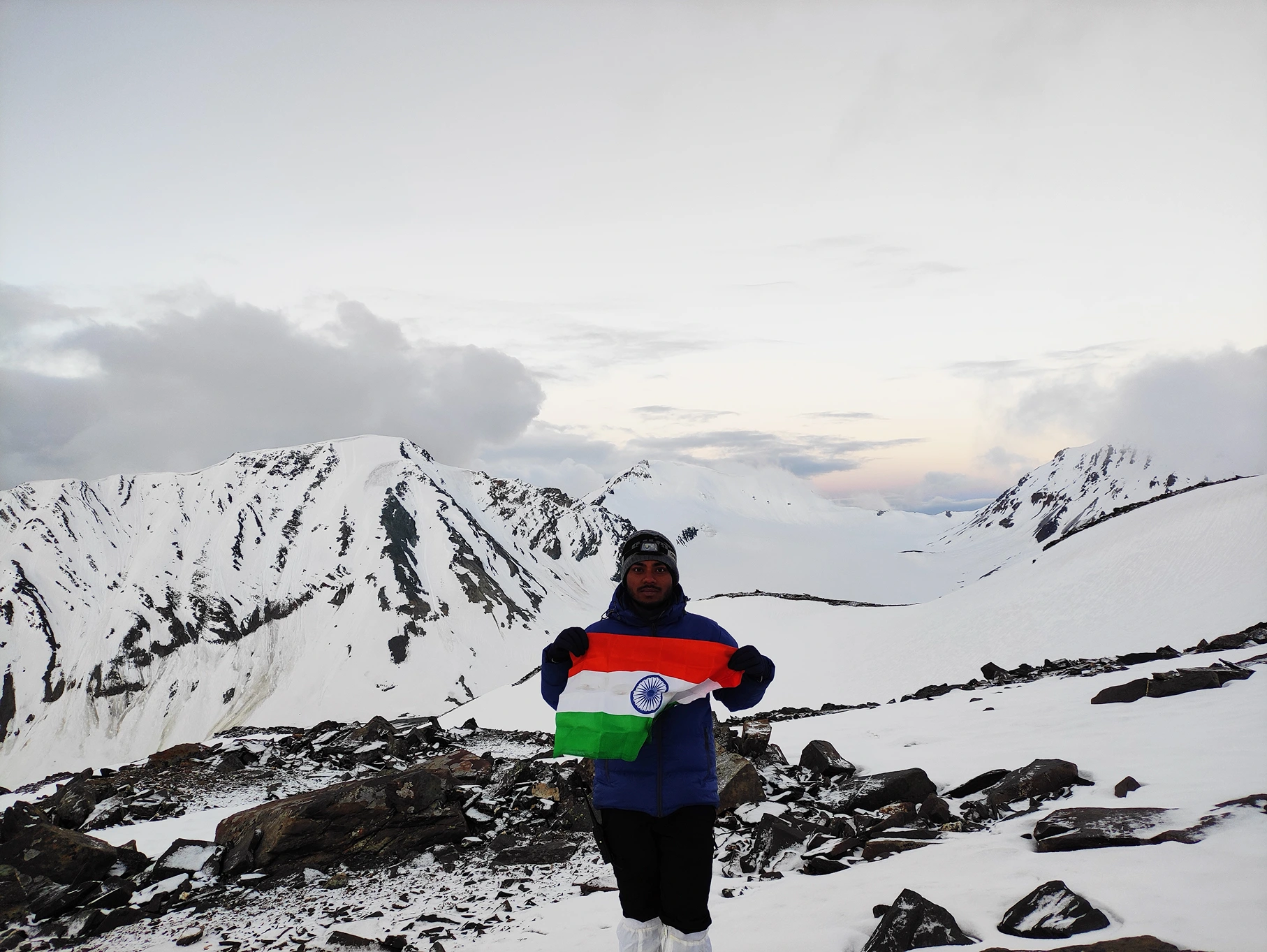
Yunam Peak Expedition rises to approximately 6,111 metres in the Lahaul region of Himachal Pradesh.
Its location near the Baralacha La region gives it a very different character from forest-based Himalayan approaches.
The landscape is stark, high, dry and expansive.
Although Yunam is frequently described as relatively non-technical compared with more complex Himalayan peaks, the altitude itself creates a serious challenge.
At more than 6,100 metres, atmospheric oxygen availability is dramatically lower than at sea level.
What Makes Yunam Peak Challenging?
The primary challenge is the combination of:
- High altitude
- Cold temperatures
- Long summit push
- Loose terrain
- Snow conditions
- Exposure to wind
- Need for careful acclimatization
Calling a mountain “non-technical” should never be interpreted as calling it easy.
At 6,111 metres, inadequate acclimatization can end an expedition regardless of how fit the climber is.
Best Months for Yunam Peak
The broad operating window generally runs from approximately June to September, with actual conditions depending heavily on road access and seasonal weather.
July, August and September can be particularly practical because the Lahaul side is accessible and the trans-Himalayan environment receives substantially less monsoon precipitation than many southern Himalayan slopes.
Who Should Attempt Yunam Peak?
Yunam can suit experienced trekkers who:
- Have previously reached 4,500–5,000 metres
- Have strong endurance
- Understand altitude acclimatization
- Want their first 6,000-metre expedition
- Are comfortable with long summit days
Previous high-altitude experience is strongly preferable.
July 2027 – Ladakh Expedition Season
July changes the geography of Himalayan climbing.
While monsoon weather affects many parts of Uttarakhand and Himachal Pradesh, Ladakh enters one of its principal expedition seasons.
This is when Kang Yatse 2 and Kang Yatse 1 become major objectives.
Both peaks rise above the Markha Valley region and can be approached through one of Ladakh’s best-known high-altitude landscapes.
But despite sharing the same massif, the two climbs are very different.
Kang Yatse 2 – A Classic 6,000-Metre Ladakh Expedition
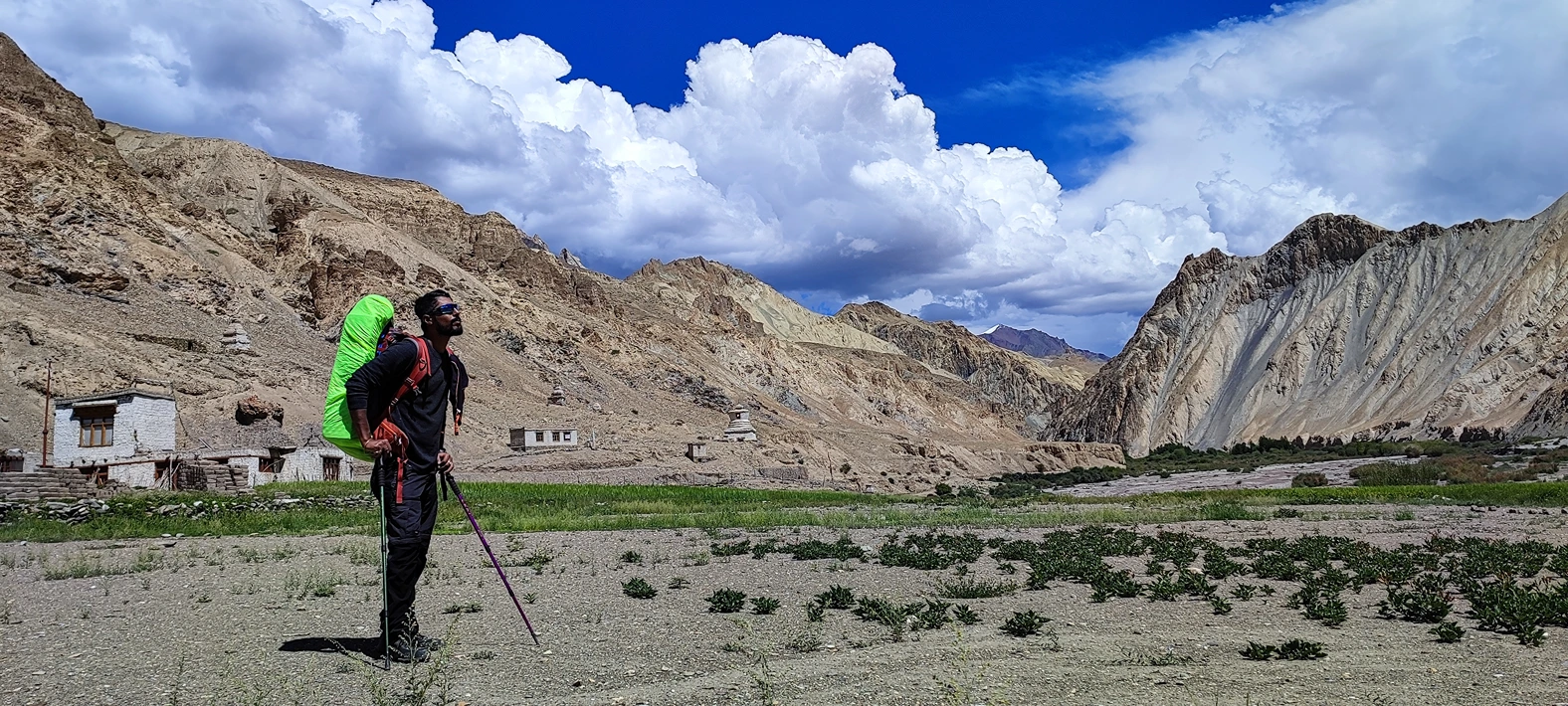
Kang Yatse 2, at approximately 6,250 metres, is one of India’s better-known introductory 6,000-metre expedition peaks.
The approach through the Markha Valley provides a natural acclimatization progression before the team reaches the mountain.
That makes the expedition particularly attractive to climbers stepping up from high-altitude trekking.
Why Choose Kang Yatse 2?
The expedition combines:
- Ladakh’s high-altitude landscape
- A multi-day approach
- Gradual acclimatization
- Snow and glacier conditions
- A genuine 6,000-metre summit
- Introduction to mountaineering equipment
The summit attempt generally requires a very early start.
Depending on conditions, climbers may use crampons, harnesses and rope systems for sections of the ascent.
Best Time for Kang Yatse 2
The primary season is generally:
July to September
July and August benefit from Ladakh’s relative protection from the Indian summer monsoon.
September can offer clearer conditions and fewer trekkers, although temperatures begin dropping as autumn advances.
Is Kang Yatse 2 for Beginners?
It is better described as an introductory expedition than a beginner trek.
A climber should ideally arrive with prior high-altitude trekking experience, excellent fitness and some familiarity with basic mountaineering techniques.
Kang Yatse 1 – A Major Step Up in Technical Difficulty
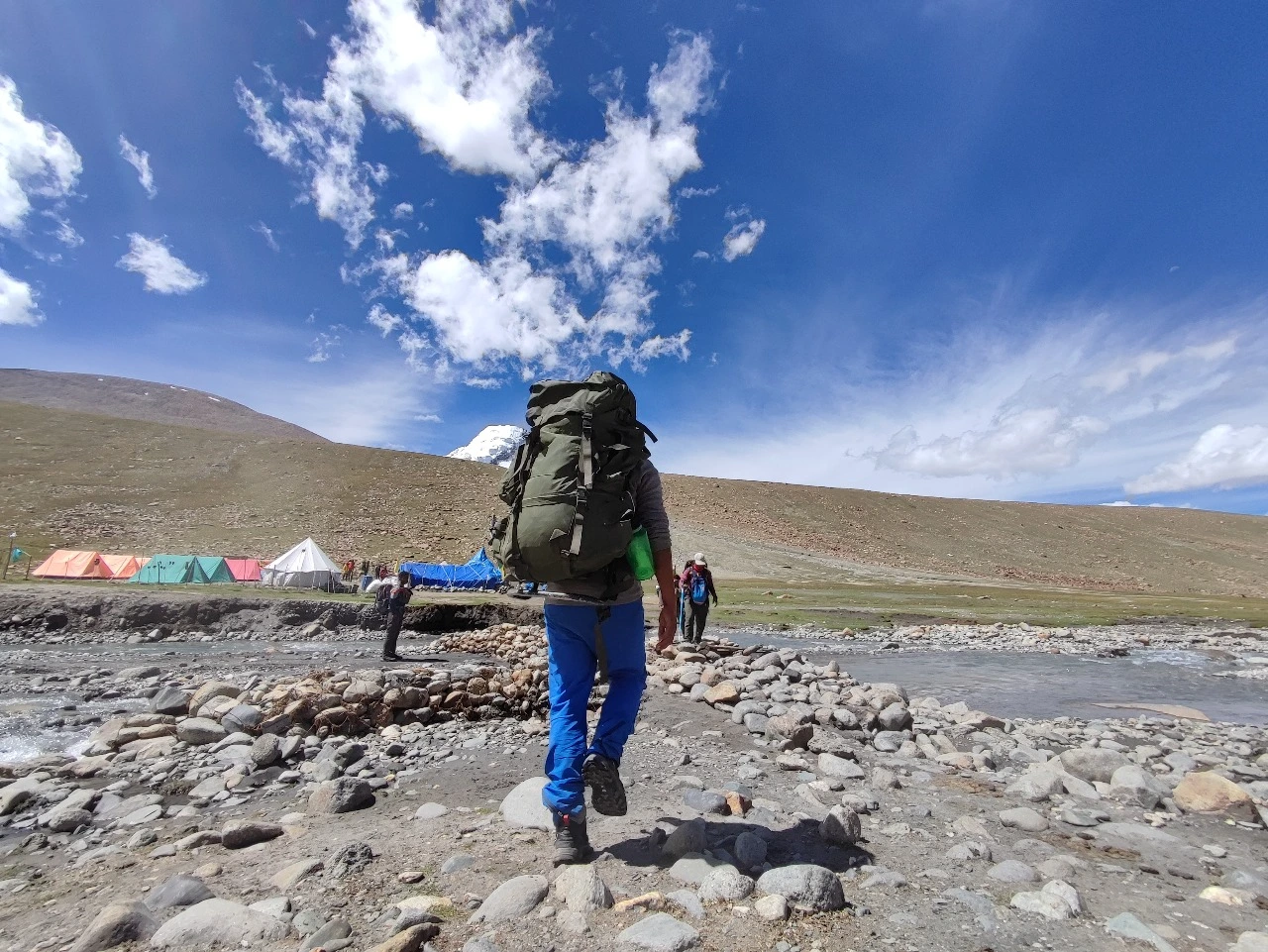
One of the most important distinctions in this entire guide is the difference between Kang Yatse 1 and Kang Yatse 2.
They should not be grouped together simply because they belong to the same mountain massif.
Kang Yatse 1, at roughly 6,400 metres, is the higher and substantially more technical objective.
It involves steeper terrain and requires stronger mountaineering competence.
Who Should Attempt Kang Yatse 1?
Kang Yatse 1 is better suited to climbers with:
- Previous 6,000-metre experience
- Glacier travel experience
- Crampon proficiency
- Rope-system familiarity
- Experience on steep snow or ice
- Excellent expedition fitness
- Sound altitude judgement
A successful Kang Yatse 2 climb can form part of a progression towards Kang Yatse 1, but completing KY2 does not automatically make someone ready for KY1.
Technical competence still matters.
Best Time for Kang Yatse 1
Like KY2, the primary climbing season generally falls between:
July and September
The exact summit window depends on snow conditions, weather and route status.
August 2027 – Prime Ladakh Expedition Month
August is one of the strongest months for mountaineering in Ladakh.
While large sections of the central Himalayas remain affected by the monsoon, the Ladakh region continues to offer comparatively dry conditions.
Best Expedition Choices in August
Kang Yatse 2 – Excellent for climbers targeting their first serious 6,000-metre summit.
Kang Yatse 1 – For experienced mountaineers looking for a significantly more technical objective.
Yunam Peak – Another strong high-altitude expedition option in the western/trans-Himalayan region.
For someone specifically searching for a 6,000-metre Indian Himalayan expedition in August, these three peaks should be high on the shortlist.
September 2027 – The Most Flexible Himalayan Expedition Month
If there is one month that deserves special attention in the Indian Himalayan Expedition Calendar 2027, it is September.
The Ladakh season is still active.
The monsoon begins withdrawing from other Himalayan regions.
Post-monsoon climbing conditions begin returning to Uttarakhand and Himachal.
This creates an unusually broad range of options.
Strong September Objectives
- Black Peak
- Yunam Peak
- Friendship Peak
- Kang Yatse 1
- Kang Yatse 2
That does not mean every peak will have ideal conditions simultaneously.
Mountain conditions must still be evaluated independently.
But from a calendar perspective, September offers perhaps the greatest variety.
October 2027 – Post-Monsoon Climbing and Colder Conditions
October can provide excellent mountain visibility in Uttarakhand and Himachal Pradesh.
The atmosphere is generally clearer after the monsoon, while rainfall decreases.
For this guide, the two principal objectives to consider are:
Black Peak
The post-monsoon season can provide another opportunity for a Black Peak expedition before winter conditions establish themselves.
Friendship Peak
Friendship Peak can also be considered during the autumn window, subject to snow and weather.
However, October brings increasingly cold nights.
As the month progresses, fresh snowfall and winter systems become more likely.
Teams should prepare for significantly lower temperatures than during the pre-monsoon season.
November 2027 – Expedition Season Winds Down
By November, the main climbing season for these five peaks is largely ending.
Winter begins establishing itself across the high Himalayas.
High camps become colder, snowfall can increase and approach routes may become difficult.
Rather than forcing an expedition into marginal conditions, November is better used for lower-altitude mountaineering, training or planning the following season.
Good expedition planning includes knowing when not to climb.
December 2027 – Review, Recover and Prepare
December completes the annual expedition cycle.
For most mountaineers, this is a time to review the year’s climbing experience and identify the next logical objective.
Ask:
What altitude have I already reached?
How well did I acclimatize?
Where did I struggle physically?
Do I need more technical training?
Am I ready to progress from trekking to mountaineering?
Or from a non-technical 6,000er to a technical 6,000er?
These questions are more useful than simply asking, “Which mountain is higher?”
Choosing the Right Peak for Your Experience Level
A sensible expedition progression might look like:
High-altitude trekking → Friendship Peak → Yunam Peak / Kang Yatse 2 → Black Peak → Kang Yatse 1 → higher or more technical Himalayan objectives
This is not a mandatory sequence.
Individual experience, formal mountaineering training and climbing background can change the progression considerably.
But the underlying principle is important:
Do not choose a mountain based only on altitude.
Technical complexity, glacier exposure, summit-day length, remoteness and weather can make a lower mountain considerably more difficult than a higher one.
Black Peak vs Yunam Peak vs Friendship Peak vs Kang Yatse 1 vs Kang Yatse 2
| Factor | Friendship Peak | Yunam Peak | Kang Yatse 2 | Black Peak | Kang Yatse 1 |
| Altitude | 5,289 m | 6,111 m | 6,250 m | 6,387 m | 6,400 m+ |
| Region | Himachal | Himachal | Ladakh | Uttarakhand | Ladakh |
| Technical Demand | Moderate | Moderate | Moderate | High | High |
| High-Altitude Challenge | Moderate | High | High | High | High |
| Glacier Skills | Useful/Condition Based | Condition Based | Required as conditions dictate | Important | Important |
| Prior Expedition Experience | Preferred | Strongly Preferred | Strongly Preferred | Recommended | Essential/Highly Recommended |
| Best For | First mountaineering summit | First 6,000er | Introductory 6,000er | Technical progression | Experienced mountaineers |
Acclimatization: The Foundation of a Successful Expedition
Fitness cannot replace acclimatization.
A marathon runner arriving directly at high altitude can experience Acute Mountain Sickness just as easily as someone with average fitness.
As altitude increases, atmospheric pressure falls and less oxygen is available with every breath.
Your body needs time to adapt.
A responsible itinerary should therefore include:
- Gradual altitude gain
- Acclimatization walks
- Adequate hydration
- Rest periods
- Conservative load management
- Symptom monitoring
- Flexibility in summit plans
Never hide altitude symptoms because you are afraid of being turned around.
A missed summit can be attempted again.
Severe altitude illness can become a medical emergency.
Fitness Required for a 6,000-Metre Himalayan Expedition
Most climbers should begin focused training at least 8–12 weeks before departure, with a longer base-building phase if starting from lower fitness.
Your training should combine:
Cardiovascular Endurance
Running, cycling, stair climbing and hiking can develop aerobic capacity.
Leg Strength
Squats, lunges, step-ups and weighted carries prepare the legs for sustained climbing.
Core Strength
A stable core becomes increasingly important when moving with a backpack or using technical equipment.
Long-Duration Hiking
Gym fitness alone is insufficient.
Spend full days walking outdoors whenever possible.
Back-to-Back Training
Expeditions require repeated effort.
Training on Saturday and again on Sunday can help prepare the body for consecutive mountain days.
Technical Skills You May Need
Requirements vary by peak and conditions, but expedition climbers should understand the purpose and basic use of:
- Crampons
- Ice axe
- Climbing harness
- Helmet
- Carabiners
- Ascender/jumar
- Descender
- Fixed ropes
- Roped glacier travel
- Self-arrest techniques
Technical peaks demand significantly more than equipment familiarity.
For Black Peak and especially Kang Yatse 1, prior mountaineering experience and formal training can be extremely valuable.
Permits and Expedition Planning in India
Mountaineering expeditions in India can require formal permissions depending on the peak, team nationality, region and current regulations.
The Indian Mountaineering Foundation (IMF) plays a central role in regulating many expeditions.
Foreign teams should pay particular attention to the application timeline.
IMF guidance states that foreign expeditions should apply preferably at least 90 days before arrival, and peak allocations are subject to availability and government clearance.
Therefore, a July 2027 expedition should not be administratively planned in June.
Begin early.
Permit rules, fees and regional requirements can change, so always verify the applicable requirements for your specific peak before departure.
Weather and Summit Success
No expedition company can guarantee a summit.
Mountains operate on weather, conditions and human physiology—not booking schedules.
Summit success can be affected by:
- Fresh snowfall
- High winds
- Whiteout
- Avalanche conditions
- Glacier changes
- Rockfall
- Team health
- Altitude sickness
- Route conditions
- Extreme cold
A professional expedition should always prioritise safe decision-making over summit statistics.
Turning around 200 metres below the summit can be the correct mountaineering decision.
Responsible Mountaineering in the Indian Himalayas
High-altitude expeditions leave a much larger logistical footprint than ordinary trekking.
Responsible teams should minimise that footprint.
Climbers should:
- Bring non-biodegradable waste back
- Avoid leaving equipment on the mountain unnecessarily
- Follow designated camping practices
- Respect local communities
- Use responsible toilet systems
- Minimise single-use plastics
- Avoid contaminating water sources
- Follow local forest and wildlife regulations
The objective should be simple:
Climb the mountain without leaving evidence that your expedition was there.
Which Indian Himalayan Peak Should You Climb in 2027?
Choose Friendship Peak if you are transitioning from trekking into mountaineering.
Choose Yunam Peak if you want to enter the 6,000-metre category and already have strong high-altitude trekking experience.
Choose Kang Yatse 2 if you want a structured 6,000-metre Ladakh expedition with an acclimatizing approach through the Markha Valley.
Choose Black Peak if you already have high-altitude experience and want a more serious technical Garhwal expedition.
Choose Kang Yatse 1 if you possess previous mountaineering experience and are ready for a substantially more technical 6,000-metre objective.
The right peak is not necessarily the highest one.
It is the peak that represents the next appropriate step in your mountaineering progression.
Final Thoughts: Planning Your Indian Himalayan Expedition in 2027
The Indian Himalayas offer an extraordinary progression for mountaineers.
You can begin around Manali with Friendship Peak, enter the 6,000-metre world on Yunam Peak, experience high-altitude expedition climbing on Kang Yatse 2, develop technical competence for Black Peak, and eventually progress towards demanding objectives such as Kang Yatse 1.
But successful expedition planning starts with the calendar.
May and June open the pre-monsoon window in Uttarakhand and Himachal Pradesh.
July and August shift attention towards Ladakh and the trans-Himalayan region.
September creates one of the broadest expedition windows of the year.
October provides selected post-monsoon opportunities before winter closes the high mountains again.
Use this Indian Himalayan Expedition Calendar 2027 to shortlist your objective—but make the final decision based on your experience, technical competence, acclimatization history and current mountain conditions.
The goal of an expedition is not merely to stand on a summit.
It is to become a stronger, safer and more capable mountaineer on every mountain you attempt.
Frequently Asked Questions
1. What is the best month for a Himalayan expedition in India?
There is no single best month across the entire Indian Himalayan region. May–June are important pre-monsoon months for parts of Himachal Pradesh and Uttarakhand, July–August are particularly useful for Ladakh, and September offers strong possibilities across several regions.
2. Which is the best first 6,000-metre peak in India?
Yunam Peak and Kang Yatse 2 are commonly considered suitable progression peaks for experienced high-altitude trekkers moving towards 6,000-metre mountaineering. Neither should be treated as an easy trek simply because their normal routes are less technical than peaks such as Black Peak or Kang Yatse 1.
3. Is Black Peak suitable for beginners?
Black Peak is better suited to climbers with previous high-altitude experience and relevant mountaineering skills. Glacier terrain, snow and ice, technical equipment and high-altitude camps make it a serious expedition.
4. What is the difference between Kang Yatse 1 and Kang Yatse 2?
Kang Yatse 2 is generally the more accessible summit and is often chosen by climbers entering the 6,000-metre category. Kang Yatse 1 is higher and substantially more technical, requiring stronger climbing and mountaineering competence.
5. How difficult is Yunam Peak?
Yunam Peak is often described as relatively non-technical, but its 6,111-metre altitude makes it physically demanding. Acclimatization, endurance, cold and summit-day length are major challenges.
6. Is Friendship Peak a trekking peak?
Friendship Peak is a mountaineering objective rather than an ordinary trek. Depending on snow conditions, climbers may need crampons, ropes and other technical equipment.
7. Which peak is best for an expedition in August?
August strongly favours the trans-Himalayan region. Kang Yatse 2, Kang Yatse 1 and Yunam Peak are among the relevant options, subject to current weather, access and route conditions.
8. Which peaks can I attempt in September 2027?
September offers one of the broadest selections. Depending on actual conditions, climbers may consider Black Peak, Friendship Peak, Yunam Peak, Kang Yatse 1 and Kang Yatse 2.
9. Do I need a mountaineering course before attempting a 6,000-metre peak?
It depends on the mountain and your existing experience. Formal training becomes increasingly valuable as the route involves glaciers, steep snow, ice, fixed ropes and technical systems. For technically demanding objectives, proper mountaineering skills should not be replaced by basic trekking experience.
10. How fit should I be for a Himalayan expedition?
You should be capable of sustained uphill movement for several hours, repeated over consecutive days. Strong aerobic endurance, leg strength, core stability and recovery capacity are essential. Training should begin several months before the expedition.
11. Do I need permits for Himalayan expeditions in India?
Permit requirements depend on the mountain, location and nationality of the climbing team. Certain expeditions require processing through the Indian Mountaineering Foundation and other authorities. Foreign expeditions should begin the application process well in advance.
12. Is summit success guaranteed on a guided expedition?
No. Weather, snow conditions, altitude illness, route safety and individual fitness can prevent a summit attempt. A responsible expedition team will turn around when continuing creates unacceptable risk.
13. How should I choose between Black Peak and Kang Yatse 2?
Choose Kang Yatse 2 if you are looking for a comparatively accessible introduction to a 6,000-metre expedition. Choose Black Peak if you already have stronger high-altitude and technical experience and want a more involved glacier and mountaineering objective.
14. Can a strong trekker attempt Kang Yatse 2?
An experienced high-altitude trekker with excellent fitness and proper acclimatization can progress towards Kang Yatse 2, ideally after learning the basic mountaineering skills required for the route.
15. How far in advance should I plan an Indian Himalayan expedition for 2027?
For major expeditions, start planning several months in advance. This provides enough time for physical training, equipment preparation, permits, travel arrangements and expedition-specific acclimatization planning. Foreign teams requiring IMF processing should pay particular attention to official application timelines.